All we propose, in return, is that you care for each other, help each other, treat each other with respect and dignity, work and play together and take your future and your children's future into your own hands and do your best to make existence into the most wholesome, meaningful experience possible for everyone.
Get it?
Showing posts with label the source. Show all posts
Showing posts with label the source. Show all posts
Thursday, September 11, 2008

Monday, September 1, 2008
conversations, presencing, change and more
A while back I had been talking about social objects - the things that give us a reason to be in a relationship with others - and how they are critical elements in the process of social transformation. Now there's a kind of magic that takes place in that fuzzy area where we interact around that thing. What goes on there? And how does it lead to transformation?
Well, recently, there have been some interesting posts on the subject. First by Chris Corrigan and later by Dave Pollard that present a distillation of how this change takes place. Here's what they look like:
Chris Corrigan's Map:
 And this, Dave Pollard's:
 And it would seem that all this is based on something called the U-Process, developed by Otto Scharmer and friends. The U-process is a kind of framework for bringing about systemic change in all kinds of organisations and groups through a collective change process and is being applied here and there to try and tackle seemingly intractable problems. It looks something like this:
 All of this makes good sense in the context of the process that we have been following in order to help Seva Mandir prepare its 6th Comprehensive plan, the meetings that we hold on a regular basis in Seva Mandir and the workshops that we have been organising with the citizen's of Delwara. For example, during the recent meeting with the women or with the 'harijans' (members of the lowest caste group, victims of great discrimination and exclusion) we have to get from a group of disparate individuals, potentially in conflict with each other, to a collective with a shared identity and a commitment to each other. In order to do this, we must travel from 'I' to 'we'. We need to open up our hearts to each other and contemplate what being together means. This is the bottom of the U. At this stage there is a sense of vibration within the group - of being connected to each other - both through minds and hearts ... and it is elevating. Once we reach this stage, translating the shared energy into concrete plans of action becomes much easier. But the process is not always either easy or smooth... and sometimes we are only partly there...
Two stages jump out as being the real critical points that need to be examined in greater depth. One is the shift into presencing. How does it happen? How long should it be sustained? The other is the taking of personal responsibility after presencing - the co-creating... How deep was the presencing? Did it hit the nail on the head? Did it cause the shift deeply enough to take the members to a whole new level? What would this take? Once we get back in our old system, out of the U-experience, we are back in those old positions, old routines, interacting with the same old people reinacting the same old patterns? Sure, if we can maintain our separateness through our newly formed group we may be able to maintain the energy... But high fall-out can be expected...
And, well, it struck me that this process is a kind of fractal - in the sense that it applies to large groups, small groups and well, why not, I suppose... Individuals? Now what would this look like at the individual level? One thing is clear: whether we are engaging in this kind of a U-process at the organisation or group level, we are dealing first and foremost with individuals.
What goes on in the individual during this process? And is there a way that an individual can experience this same transition from one state to another on their own? Is it necessarily a collective process? Is it only through my being and doing with others that I can bring about transformation in myself? If not, is meditation or reflection what this looks like at the personal level? Do I have to disconnect myself from my daily life in order to get there? Am I already there? Can I do this willingly? Can I presence perpetually? Is it more about a state of being?
And can this be done at the level of a community as a whole? What would be the method? How would we get a multitude of fragmented individuals and groups to gradually 'vibrate in harmony' as it were? What is the deepest collective presencing possible for a whole community and how do we get there?
I don't know what the answers are to any of these questions... but they do look like they matter!
And, I suppose, this is where the work that Seva Mandir really fits in. It can provide not just the U experience but it can also do the groundwork to prepare for entry and do the follow-up work to support what comes after. It not only gets people ready to dive in, it not only helps them to access the source, but it also provides support in enacting whatever comes next. Still though, ultimate responsibility lies in the hands of the people themselves. We give no instructions.
But the real question is how deep we get in the U process. This seems key to everything. If we get to the source, where would it take us? What would it take for us to get there? I think we cannot know the answer until we walk the path... And convincing anyone to embark on something that has no clear destination is not easy - although it seems more and more people are talking about this - facilitators, knowledge management experts, and more. But, wedged in all the entanglements of organisational reality - accountability, reports, targets, and the like - how do we do this (by Tom Atlee, hat tip to Dave Pollard)? The unknown or everything that we know (however bad it may be)? How do we prepare people for this kind of trade-off?
My mission in life, forgive me for this, is to facilitate a conscious evolutionary process. Yes, I read these words today on Tom Atlee's site, but I have known this (in these very words) as long back as 6 years ago. In order to do this I need to understand exactly how we connect to the source in the most effective manner to bring about the individual and collective shifts that are required, to harmonise humanity with the flow of nature and liberate the full potential of human spirit. For this I need to know how to get people, systems and everyone else on-board. How to connect people in this quest in the most effective manner. This is what I need to learn. And this is what I need to get from my studies.
Let's see where this road takes me ;)
Well, recently, there have been some interesting posts on the subject. First by Chris Corrigan and later by Dave Pollard that present a distillation of how this change takes place. Here's what they look like:
Chris Corrigan's Map:
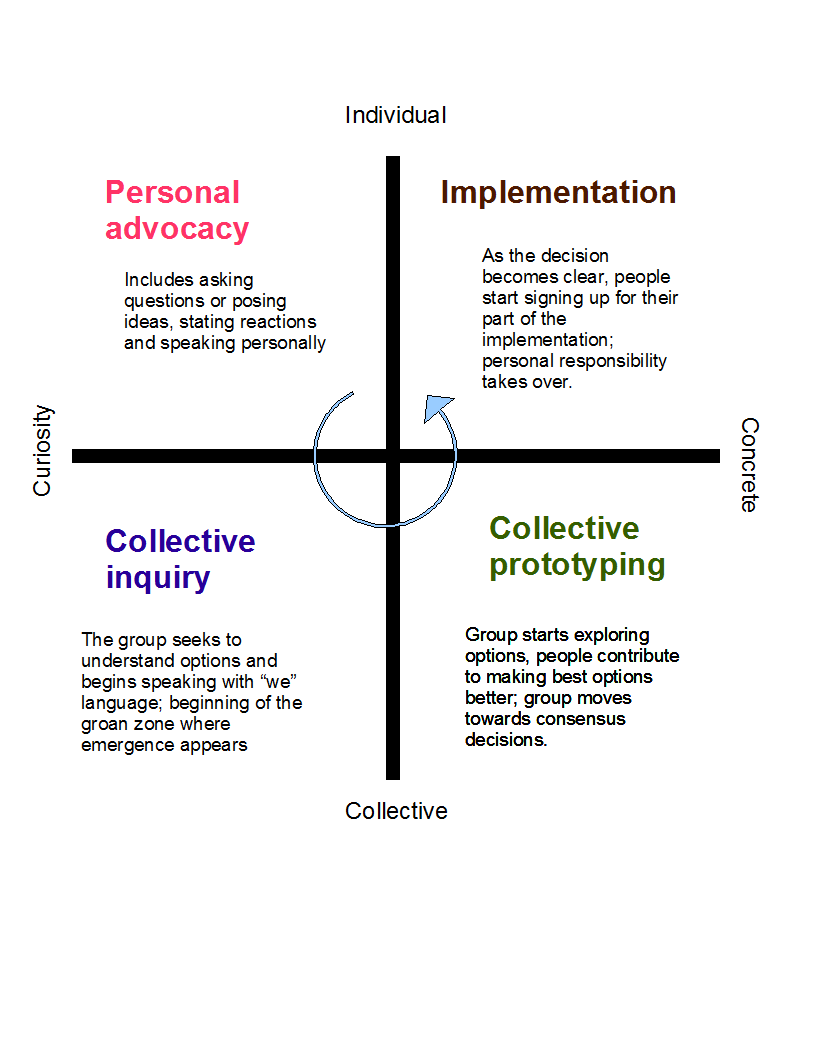 And this, Dave Pollard's:
 And it would seem that all this is based on something called the U-Process, developed by Otto Scharmer and friends. The U-process is a kind of framework for bringing about systemic change in all kinds of organisations and groups through a collective change process and is being applied here and there to try and tackle seemingly intractable problems. It looks something like this:
 All of this makes good sense in the context of the process that we have been following in order to help Seva Mandir prepare its 6th Comprehensive plan, the meetings that we hold on a regular basis in Seva Mandir and the workshops that we have been organising with the citizen's of Delwara. For example, during the recent meeting with the women or with the 'harijans' (members of the lowest caste group, victims of great discrimination and exclusion) we have to get from a group of disparate individuals, potentially in conflict with each other, to a collective with a shared identity and a commitment to each other. In order to do this, we must travel from 'I' to 'we'. We need to open up our hearts to each other and contemplate what being together means. This is the bottom of the U. At this stage there is a sense of vibration within the group - of being connected to each other - both through minds and hearts ... and it is elevating. Once we reach this stage, translating the shared energy into concrete plans of action becomes much easier. But the process is not always either easy or smooth... and sometimes we are only partly there...
Two stages jump out as being the real critical points that need to be examined in greater depth. One is the shift into presencing. How does it happen? How long should it be sustained? The other is the taking of personal responsibility after presencing - the co-creating... How deep was the presencing? Did it hit the nail on the head? Did it cause the shift deeply enough to take the members to a whole new level? What would this take? Once we get back in our old system, out of the U-experience, we are back in those old positions, old routines, interacting with the same old people reinacting the same old patterns? Sure, if we can maintain our separateness through our newly formed group we may be able to maintain the energy... But high fall-out can be expected...
And, well, it struck me that this process is a kind of fractal - in the sense that it applies to large groups, small groups and well, why not, I suppose... Individuals? Now what would this look like at the individual level? One thing is clear: whether we are engaging in this kind of a U-process at the organisation or group level, we are dealing first and foremost with individuals.
What goes on in the individual during this process? And is there a way that an individual can experience this same transition from one state to another on their own? Is it necessarily a collective process? Is it only through my being and doing with others that I can bring about transformation in myself? If not, is meditation or reflection what this looks like at the personal level? Do I have to disconnect myself from my daily life in order to get there? Am I already there? Can I do this willingly? Can I presence perpetually? Is it more about a state of being?
And can this be done at the level of a community as a whole? What would be the method? How would we get a multitude of fragmented individuals and groups to gradually 'vibrate in harmony' as it were? What is the deepest collective presencing possible for a whole community and how do we get there?
I don't know what the answers are to any of these questions... but they do look like they matter!
And, I suppose, this is where the work that Seva Mandir really fits in. It can provide not just the U experience but it can also do the groundwork to prepare for entry and do the follow-up work to support what comes after. It not only gets people ready to dive in, it not only helps them to access the source, but it also provides support in enacting whatever comes next. Still though, ultimate responsibility lies in the hands of the people themselves. We give no instructions.
But the real question is how deep we get in the U process. This seems key to everything. If we get to the source, where would it take us? What would it take for us to get there? I think we cannot know the answer until we walk the path... And convincing anyone to embark on something that has no clear destination is not easy - although it seems more and more people are talking about this - facilitators, knowledge management experts, and more. But, wedged in all the entanglements of organisational reality - accountability, reports, targets, and the like - how do we do this (by Tom Atlee, hat tip to Dave Pollard)? The unknown or everything that we know (however bad it may be)? How do we prepare people for this kind of trade-off?
My mission in life, forgive me for this, is to facilitate a conscious evolutionary process. Yes, I read these words today on Tom Atlee's site, but I have known this (in these very words) as long back as 6 years ago. In order to do this I need to understand exactly how we connect to the source in the most effective manner to bring about the individual and collective shifts that are required, to harmonise humanity with the flow of nature and liberate the full potential of human spirit. For this I need to know how to get people, systems and everyone else on-board. How to connect people in this quest in the most effective manner. This is what I need to learn. And this is what I need to get from my studies.
Let's see where this road takes me ;)
Friday, August 29, 2008
the guru illusion (yeh guruwuru kya hai yaar?)
I am increasingly feeling myself anti-guru - at least in the traditional sense. Some great posts from Mushin who deconstructed his own guru role helped strengthen this feeling in me - although it has been there for quite some time (this is one example). More recently, I was chatting to someone about Baba Asharam Dev here in India who has been implicated in the killing of a child in his ashram as a way of building up religious fervour... Now, this guy has a massive following and loads of money. But why do people place their faith in some distant bearded figure whose words and actions could well have nothing to do with each other!?
The idea that emancipation is possible through one of these bearded fellows who sits on a pedastal is bullshit. Until we learn to realise that God (for want of a better word) exists within ourselves and all those around us, we will spend our lives sitting in the shadow of obscure religious figures whose real nature is as elusive as the very truth we are searching for. What we need is an alternative model for guru. One that ties in more deeply to the social reality that we are confronted with in the present age: loss of community, fragmentation, competitive individualism and the spate of horrors that this brings with it. We need a new conception of guru that embodies collective, distributed wisdom that can transport us to higher levels of collective being.
One simple way of approaching this is to look for the truth in the people who share our immediate circle: one's partner, one's children, one's neighbours, one's community. Can we see the truth in each person? Can one see the wisdom and teaching that each carries? Can we embrace our total lived experience as the guru, seeking the truth, the love, the wisdom or the lesson that can transport us higher in everything around us?
As Lao Tse puts it: "...the good teach the bad/ and the bad are lessons for the good". There is nothing that carries no teaching.
To do this requires the greatest of all powers: having an open heart. Can I have space in my heart for the other? Can I embrace the unknown? Can I let go? Can I dissolve all my boundaries? Can you do it with me?
Let us speak openly and from the heart about things that matter to us. Let us reach out to those who are least heard and let each other into our hearts and let this be the foundation of our families, our communities, our work places and our societies. Then let the guru emerge from our collective interactions and let that be our guide for the future.
What need is there to give more advice than this? Surely the rest will follow from the process!
The idea that emancipation is possible through one of these bearded fellows who sits on a pedastal is bullshit. Until we learn to realise that God (for want of a better word) exists within ourselves and all those around us, we will spend our lives sitting in the shadow of obscure religious figures whose real nature is as elusive as the very truth we are searching for. What we need is an alternative model for guru. One that ties in more deeply to the social reality that we are confronted with in the present age: loss of community, fragmentation, competitive individualism and the spate of horrors that this brings with it. We need a new conception of guru that embodies collective, distributed wisdom that can transport us to higher levels of collective being.
One simple way of approaching this is to look for the truth in the people who share our immediate circle: one's partner, one's children, one's neighbours, one's community. Can we see the truth in each person? Can one see the wisdom and teaching that each carries? Can we embrace our total lived experience as the guru, seeking the truth, the love, the wisdom or the lesson that can transport us higher in everything around us?
As Lao Tse puts it: "...the good teach the bad/ and the bad are lessons for the good". There is nothing that carries no teaching.
To do this requires the greatest of all powers: having an open heart. Can I have space in my heart for the other? Can I embrace the unknown? Can I let go? Can I dissolve all my boundaries? Can you do it with me?
Let us speak openly and from the heart about things that matter to us. Let us reach out to those who are least heard and let each other into our hearts and let this be the foundation of our families, our communities, our work places and our societies. Then let the guru emerge from our collective interactions and let that be our guide for the future.
What need is there to give more advice than this? Surely the rest will follow from the process!
Thursday, August 7, 2008
social capital - possibility is in our hands
Another long-standing topic that I am finally getting around to putting on my blog... and a good follow-up for the previous blog. It struck me one day in Delwara as I found myself trying to stop two 'community leaders' from neighbouring communities - one a tribal (Gameti) the other a scheduled caste (Meghwal - traditionally tanners/leather-workers).
The fight was over some misunderstanding/miscommunication rather than any real transgression though there were some territorial undertones. I was standing on top of a pile of sand on top of the hill upon which the tribal community has built their basti. It's a beautiful location and the houses there have the best view of the whole village - including the Devigarh fort. Of course, it's cramped up there, there's no water supply (a real problem for the women and young girls who fetch it), and the community is one of the poorest in the village so - relative freedom aside - life is pretty tough for the inhabitants.
I once watched an 80 year-old man on top of that hill crushing rocks next to a 4x6 foot stone cubicle with no roof (which, I discovered later was his home). This involve hammering a 6" iron nail into the rocky ground by banging it with a big stone. In the corner of the cubicle was a little hand-made earthern stove with some ashes at the bottom of it. The old man was too old to really earn any money through labour work. He got most of his meals from the neighbours - which they gave up with what seemed like a mix of reluctance and obligation. After the community sent an application to the citizen's forum, roofing was arranged - just in time to keep his home dry as the monsoon rains started a few days later. By the time we went to put the roof up, he had expanded his house to around 7x6 feet using the stones he had been crushing right there on the spot. Amazing.
In any case, back to the fight. So, there had been some miscommunication. The meghwal chap was working as a mason on the construction work of a water tank. Some mistrust had emerged over the issue of whether work was properly being distributed between therespective labourers of the tribal and the Meghwal community. By the time I was at the site, the situation was pretty bad. There was shouting, throwing of insults, angry faces, high BP, and people throwing their hands up in the air. It reached the point where the parties were shouting that no water tank would be built in that location. Well, there goes the reliable, convenient water source for about 50 families.
As I stood on top of that hill and calmed the people down, shifted the blame onto myself and my team (we did have an unfortunate hand in propagating the miscommunication - it happens sometimes that false information circulates unintentionally in the messy, complex chaos that gets called 'the community') , calmed the two people down, and re-established the fact that the water tank really was a good idea and that everything was going to be ok I found myself thinking about social capital... and my thoughts went something like this...
Social capital is a form of 'the commons'. It is, perhaps, the most fundamental form of 'the commons'. Traditionally 'the commons' has referred to natural resources - initially pasture lands on which shepherds could graze their cattle and later it has expanded to include things like the climate or biodiversity. But my sense is that we really need to start talking about what it is that holds all these things together - what it is that we need to restore if we want to address the tragedy of these commons. And that thing is social capital: our relationships and the potential they represent for enriching lives.
Social capital is the common resource that has been most ignored and most overlooked in the general discourse on the commons. It is like a vast, untapped - almost infinite - sea - like the internet - source of potential for creating the world in new and wonderful ways. If we have high levels of social capital - deep, meaningful relationships with each other that are bursting with opportunities for collaboration - jointly making things happen in ways that are mutually beneficial - then what can't we achieve?
Unlike the traditional and modern commons - our grazing lands and the ecosphere for example - social capital (can we venture calling it community?) has a direct link with our assumptions, biases and prejudices: the way we perceive ourselves, others and the relationship in-between. For example, do we distinguish people - either consciously or unconsciously - according to religion, caste, gender, age, class, education status, appearance, position within an organisation? Do we assign different levels of trust/mistrust based on this? Do we open or close opportunities for working together or, for that matter, even talking to each other based on this?
Every time I make a judgement based on identity and foreclose an interaction, an opportunity to understand, listen, engage and build a relationship, I am simultaneously denying myself and the other person an opportunity to acquire social capital. And this appears to be the most defining feature of what still seems to get called 'community' in this communally dilapidated age. Walls exist everywhere, between everyone, and the result is a bunch of isolated people who can't even have the conversations that they need to have to begin thinking about what it would take to change the world for the better.
I'm not entirely sure what I'm trying to get at here but I think the main point is that if we want to ever start the process of addressing the world's biggest problems we need to engage in a very real way with some of the very smallest. Why do I call it the smallest? Well, given my (perhaps naieve) sense of how the world works - one's own behaviour is the only thing that one really has any control over. I'm not trying to say that it's easy and I don't mean to sound corny but it really does make sense. So it seems that part of saving the world is helping people to realise that they can have control over themselves, and that collectively, if a group of individuals can wake up to this call for taking responsibility for their own behaviour, they can access a vast sea of social capital just waiting to be unleashed as a force for creating a better world together
Create the opportunities - the spaces and the call to get inside them and tap into the source of community. Let them do it!
The fight was over some misunderstanding/miscommunication rather than any real transgression though there were some territorial undertones. I was standing on top of a pile of sand on top of the hill upon which the tribal community has built their basti. It's a beautiful location and the houses there have the best view of the whole village - including the Devigarh fort. Of course, it's cramped up there, there's no water supply (a real problem for the women and young girls who fetch it), and the community is one of the poorest in the village so - relative freedom aside - life is pretty tough for the inhabitants.
I once watched an 80 year-old man on top of that hill crushing rocks next to a 4x6 foot stone cubicle with no roof (which, I discovered later was his home). This involve hammering a 6" iron nail into the rocky ground by banging it with a big stone. In the corner of the cubicle was a little hand-made earthern stove with some ashes at the bottom of it. The old man was too old to really earn any money through labour work. He got most of his meals from the neighbours - which they gave up with what seemed like a mix of reluctance and obligation. After the community sent an application to the citizen's forum, roofing was arranged - just in time to keep his home dry as the monsoon rains started a few days later. By the time we went to put the roof up, he had expanded his house to around 7x6 feet using the stones he had been crushing right there on the spot. Amazing.
In any case, back to the fight. So, there had been some miscommunication. The meghwal chap was working as a mason on the construction work of a water tank. Some mistrust had emerged over the issue of whether work was properly being distributed between therespective labourers of the tribal and the Meghwal community. By the time I was at the site, the situation was pretty bad. There was shouting, throwing of insults, angry faces, high BP, and people throwing their hands up in the air. It reached the point where the parties were shouting that no water tank would be built in that location. Well, there goes the reliable, convenient water source for about 50 families.
As I stood on top of that hill and calmed the people down, shifted the blame onto myself and my team (we did have an unfortunate hand in propagating the miscommunication - it happens sometimes that false information circulates unintentionally in the messy, complex chaos that gets called 'the community') , calmed the two people down, and re-established the fact that the water tank really was a good idea and that everything was going to be ok I found myself thinking about social capital... and my thoughts went something like this...
Social capital is a form of 'the commons'. It is, perhaps, the most fundamental form of 'the commons'. Traditionally 'the commons' has referred to natural resources - initially pasture lands on which shepherds could graze their cattle and later it has expanded to include things like the climate or biodiversity. But my sense is that we really need to start talking about what it is that holds all these things together - what it is that we need to restore if we want to address the tragedy of these commons. And that thing is social capital: our relationships and the potential they represent for enriching lives.
Social capital is the common resource that has been most ignored and most overlooked in the general discourse on the commons. It is like a vast, untapped - almost infinite - sea - like the internet - source of potential for creating the world in new and wonderful ways. If we have high levels of social capital - deep, meaningful relationships with each other that are bursting with opportunities for collaboration - jointly making things happen in ways that are mutually beneficial - then what can't we achieve?
Unlike the traditional and modern commons - our grazing lands and the ecosphere for example - social capital (can we venture calling it community?) has a direct link with our assumptions, biases and prejudices: the way we perceive ourselves, others and the relationship in-between. For example, do we distinguish people - either consciously or unconsciously - according to religion, caste, gender, age, class, education status, appearance, position within an organisation? Do we assign different levels of trust/mistrust based on this? Do we open or close opportunities for working together or, for that matter, even talking to each other based on this?
Every time I make a judgement based on identity and foreclose an interaction, an opportunity to understand, listen, engage and build a relationship, I am simultaneously denying myself and the other person an opportunity to acquire social capital. And this appears to be the most defining feature of what still seems to get called 'community' in this communally dilapidated age. Walls exist everywhere, between everyone, and the result is a bunch of isolated people who can't even have the conversations that they need to have to begin thinking about what it would take to change the world for the better.
I'm not entirely sure what I'm trying to get at here but I think the main point is that if we want to ever start the process of addressing the world's biggest problems we need to engage in a very real way with some of the very smallest. Why do I call it the smallest? Well, given my (perhaps naieve) sense of how the world works - one's own behaviour is the only thing that one really has any control over. I'm not trying to say that it's easy and I don't mean to sound corny but it really does make sense. So it seems that part of saving the world is helping people to realise that they can have control over themselves, and that collectively, if a group of individuals can wake up to this call for taking responsibility for their own behaviour, they can access a vast sea of social capital just waiting to be unleashed as a force for creating a better world together
Create the opportunities - the spaces and the call to get inside them and tap into the source of community. Let them do it!
Thursday, July 24, 2008
visions, dreams, problem-solving and change
So, I’m pretty sure that I’m not saying anything new here (I have been thinking about it for a while and have taken inspiration from numerous sources and even woven it into my own practice)… but it does kind of strike me as being rather important… here it goes:
One thing is for sure: the dream-based leadership workshop that we conducted in Delwara – which included an exercise for linking people’s own actions to the realization of their dreams – worked! Within a few days, a Muslim lady – a local leader – was out and about in her neighbourhood trying to collect money from each household to cover the cost of getting the neighbourhood cleaned on a regular basis. And just the other day, I was translating for a volunteer studying the relationship between women and water in Delwara, and two women quite clearly recounted: “it’s not that we didn’t have dreams before the Citizen’s Forum was established, it’s just that we didn’t have a way of realizing them”.
This is an urgent plea to not let ourselves start trying to possess other people’s dreams and to focus instead on trying simply to listen to, know and understand them, to get people to own up to having them and to cultivate a passion for realizing them – both individually and collectively!
I sincerely believe that these dreams are the source from which any glimmer of hope for positive social change emerges. As such, they are worthy of unfathomable respect.
- Vision-driven change is completely different from problem-solving-driven change.
- For the most-part, people are uncomfortable with moving away from problem-solving
- Vision-driven change requires an understanding of the problems but, instead of beginning with the problems, begins with tapping into people’s dreams, unearthing them, sharing them, building common dreams and then catalyzing collective action around these dreams
- Vision-driven change and problem-solving-driven change are not mutually exclusive… but putting the vision gives a better context for the problem-solving
- Vision-driven change is all about creating new realities – this gives a real sense of moving forward towards something that is desirable rather than simply away (or aside from) something that is bad
- Problem-solving change is all about trying to get out of slippery holes – getting out of one doesn’t mean that you haven’t fallen into another
- Vision-driven change is holistic, and presents an inclusive and clear goal that people can both relate and aspire to
- Problem-solving change is fragmented, and often fails to consider how one problem is linked to the next – it also often encourages looking for solutions at levels that are far beyond people’s grasp
One thing is for sure: the dream-based leadership workshop that we conducted in Delwara – which included an exercise for linking people’s own actions to the realization of their dreams – worked! Within a few days, a Muslim lady – a local leader – was out and about in her neighbourhood trying to collect money from each household to cover the cost of getting the neighbourhood cleaned on a regular basis. And just the other day, I was translating for a volunteer studying the relationship between women and water in Delwara, and two women quite clearly recounted: “it’s not that we didn’t have dreams before the Citizen’s Forum was established, it’s just that we didn’t have a way of realizing them”.
This is an urgent plea to not let ourselves start trying to possess other people’s dreams and to focus instead on trying simply to listen to, know and understand them, to get people to own up to having them and to cultivate a passion for realizing them – both individually and collectively!
I sincerely believe that these dreams are the source from which any glimmer of hope for positive social change emerges. As such, they are worthy of unfathomable respect.
Friday, July 11, 2008
Trying to get some bearings...
It's been a while since I managed to get back to the blog and I have a lot to say. At the same time, I really want to learn how to say whatever I am trying to say in less space. One approach could be to use several smaller blog postings (to create the illusion of using less space). Another is to try and use visual media (to really use less space). I think I will use a combination of the two.
In any case, here are the main things on my mind that I want to blog about a little bit more (though not in any particular order) in the coming days:
In any case, here are the main things on my mind that I want to blog about a little bit more (though not in any particular order) in the coming days:
- How most communication takes place (and why)
- How this leads to the mess we're in (and why)
- What getting out of it might involve (and why)
- The place for spirituality in all this (and why)
- Re-visiting my early reflections on Action Science
- Reading Dave Snowden's work on stories and complexity
- My recent engagement with anthropology
- Reading the Katha Upanishad and the Tao Te Ching
- Facilitating communication between a volunteer and organisational staff
- Witnessing various conflicts within my 'home' and within the organisation
- Late night and other engaging discussions with friends on much of the above
- A good bit of improvised fictional story-circle
- Some reflections on stepping out into the unknown and how this makes me feel
Sunday, May 18, 2008
Hearing the Call
Even as I wrote the title of this blog, I found myself confused. Which goes to show just how things are at the moment. Working on a process of organisational change is a rather tricky thing indeed. For whom, exactly, are we changing? What is this change and why are we doing it? These may seem like obvious questions with equally clear answers. However, I assure you that they aren't. And the more I get caught up in the process, the harder it becomes for me to really know what is up and what is down.
Working in an organisation with a particular culture and achieving particular results gives out a particular feel. A feel about what is right, what is working and what isn't. There is another set of feelings, which is personal, deeply internal: what do I feel it should be. In between these two domains there is a kind of space. Focusing on that space makes me feel cross-eyed. Maybe that's because I feel tired. Is this the same space that I had referred to in an earlier blog? The one between the two extremes of the pendulum swing from organisational worldview to andre worldview? Because that was a kind of pleasant space, a state to be achieved, one much desired, where all is open and flowing and just how it should be.
This space, however, is the other extreme. It is incredibly dense, like a kind of thick, multi-demensional knot that clearly demarcates this from that. It is not possible to really comtemplate it. It seems, in a way, like what a paradigm shift would look like if you could see one; a kind of thick wall where almost all the rules, logic and outcomes on one side are distinct from all the rules, logic and outcomes on the other. This wall radiates energy so powerfully that it almost repels any sort of an attempt to cross from one side to the other... mainly by making whoever attempts go cross-eyed or that their brain is going to, quite simply, snap.
I think this is probably a sign that I need to rest :) If I want to hear that call, I had better turn off my system for a little while and let things cool down, let the knots unravel, eat some good food, go for a stroll and then sleep like a dog!
Thanks,
Andre
Working in an organisation with a particular culture and achieving particular results gives out a particular feel. A feel about what is right, what is working and what isn't. There is another set of feelings, which is personal, deeply internal: what do I feel it should be. In between these two domains there is a kind of space. Focusing on that space makes me feel cross-eyed. Maybe that's because I feel tired. Is this the same space that I had referred to in an earlier blog? The one between the two extremes of the pendulum swing from organisational worldview to andre worldview? Because that was a kind of pleasant space, a state to be achieved, one much desired, where all is open and flowing and just how it should be.
This space, however, is the other extreme. It is incredibly dense, like a kind of thick, multi-demensional knot that clearly demarcates this from that. It is not possible to really comtemplate it. It seems, in a way, like what a paradigm shift would look like if you could see one; a kind of thick wall where almost all the rules, logic and outcomes on one side are distinct from all the rules, logic and outcomes on the other. This wall radiates energy so powerfully that it almost repels any sort of an attempt to cross from one side to the other... mainly by making whoever attempts go cross-eyed or that their brain is going to, quite simply, snap.
I think this is probably a sign that I need to rest :) If I want to hear that call, I had better turn off my system for a little while and let things cool down, let the knots unravel, eat some good food, go for a stroll and then sleep like a dog!
Thanks,
Andre
Subscribe to:
Posts (Atom)