Showing posts with label learning. Show all posts

Monday, December 1, 2008

What I've been doing

The way that can be described is not the absolute way...
-- Lao Tse

It's been a while since I last posted and so I feel the need to explain my absence from the blogosphere to the world. The basic justification is that I have been immersing myself in my MA in Participation Power and Social Change and, more specifically, the preparation of my Analytical Paper. The Analytical Paper is, essentially, supposed to be a kind of concept paper that can be used to frame the work I will be doing when I return to Seva Mandir. It will combine a contextual analysis, a conceptual framework and an overview of how I plan to go about addressing the questions that I intend to ask.

I won't go into the context just here, but the conceptual framework seems worth sharing. Essentially, I will be locating my action research project at the theoretical intersection of three main domains: complexity, power and learning.
There are plenty of theories related to each of these domains and I have been seeking out the particular ones where they converge. This has led me to a number of texts that have quite significantly contributed to the way that I think about my participation in the universe - and particularly in social life.

So far my learning journey here at IDS seems to have given me a much more solid understanding of the more philosophical dimensions of the work that I am involved in. In particular, I have come to gain a more solid understanding of the idea of 'epistemology' - a word I had often heard, sometimes used but whose definition (and importance) I had never understood so completely. I have also manged to explore the linkages between knowledge and power and understand how participatory action research serves to transform power relations by engaging people in the creation of new knowledge.

I have also had the opportunity to explore Mezirow's work on Transformative Learning:
"the emancipatory process of becoming critically aware of how and why the structure of psycho-cultural assumptions has come to constrain the way we see ourselves and our relationships, reconstituting this structure to permit a more inclusive and discriminating integration of experience and acting upon these new understandings."
Combined with Hayward's (2000) reconceptualisation of power as 'the network of social boundaries to action' and the very important observation that the very idea of negative freedom is absurd (she argues instead for a positive and political form of freedom), all this has amounted to a rather powerful set of concepts that have been making me continuously rethink the nature of and my engagement in the world.

On top of all this, I have been trying to familiarise myself with Ralph Stacey and the idea of complex responsive processes. Stacey has perhaps provided me with the most radical worldview of all. Three papers, all available for free, can be downloaded from his university website:
Together these provide a fairly powerful explanation of the relationship between the individual and the social, consciousness and unconscioussness, meaning, knowledge, learning, identity, power and communication all from within a complexity-based framework. I have been doing plenty of learning by explaining and this has really helped me to internalise some of these new ways of seeing the world. I really don't think I can think about anything the same way again!

In that fuzzy space where complexity theory, power theory and learning theory intersect, I will be conducting my action research; exploring the ways in which I can engage in conversations that bring about positive transformation in human organisations (both Seva Mandir and the communities). I think it's going to be a lot of fun! The essay, however, which will only be 5,000 words, is going to be a bit of a challenge. So much to say, and so little space!

On a somewhat different note, I have been having a lot of really great conversations. Feedback - and the need for it - has been one of the recurring themes, as has the need to explore power relations within our learning group, and my Analytical Paper (of course)... Tomorrow will be the second complexity world cafe in which we will recap the last session, go over the concepts that had not been covered previously and then have some further conversations to explore what some of this might mean for practice... It will be interesting to see what kind of energy is present in the room as it will probably be my last opportunity to participate in one of these sessions for sometime :) I can't help but hope that this process of exploring complexity gets the wind under its wings!

It is now way past my bedtime! Sweet dreams!

Tuesday, November 18, 2008

rights or responsibilities

Well, miraculously the essay slipped out without too much anguish :) Actually, the writing process was a really good exercise for helping me to digest a whole load of reading materials that I have found rather insightful. Now with that behind me I have got my senses set on the upcoming 'Analytical Paper' that I will need to have ready by December 10th. This will be the place in which I present the conceptual and contextual framing of the work that I will be doing when I return to India. Fortunately, it has been taking shape quite nicely thanks to some good discussions with fellows, researchers, students and myself ;) I will, however, need a designated supervisor (and don't have one yet!)...

The emerging framework for my action inquiry is one that uses complexity, learning and power lenses to study processes of facilitating learning for change at multiple levels including (1) myself (as a reflective facilitator); (2) individuals in the organisation; (3) the organisation as a whole; (4) the communities with whom the organisation works.

Otherwise I experienced a rather wonderful sense of joy recently as our class had a kind of epiphany about its responsibility for actively shaping its own learning process. I've been fascinated with the way the course is unfolding. Simply observing and reflecting on this has made for a very profound learning process indeed! I also believe that it has reinforced some of my thinking about the rights-responsibilities debate that surfaces quite often back at Seva Mandir. Knowing that we had the right to shape the process and realising that it was our responsibility to shape our process; how do these two ideas complement each other? Does the one need the other? What is a right that is not realised?

I read something today that talked of the right of people to create "...authentic, caring, sustainable communities, to control their resources, to govern themselves, and guide their own evolution..." In what way is this not the people's responsibility? Claiming rights or taking responsibility? Is there any difference? Rights only become realised when people take responsibility. But does the process of claiming rights somehow short-circuit the deeper cultural change that occurs when people frame their process as one of taking individual and collective responsibility for co-creating a different reality? Is it merely some combination of the two? Why am I so much more concerned with responsibilities than rights? Is it because responsibility implies rights but rights don't imply responsibilities? If I have a right but don't make any effort to claim it, whose fault is that? Perhaps this seems decontextualised!?

Back to our class, if we had the right to shape our learning process but didn't take the responsibility, then what would it mean? And if we were not told that we had the right to shape our learning process but were only told that we had the responsibility for shaping it - then might that have triggered a more pro-active reaction from the outset? I recently posted the following on a new wordpress blog that I am experimenting with (exploring the added functionality that might prove useful for my documenting my learning journey!) as part of my wonderings:

Is the language of responsibilities more powerful than the language of rights? Does it invoke more action on behalf of the would-be ‘right-claimers’? Is the whole ‘rights’ framework a ‘Northern’ construction that is being pushed on the rest of the world (along with so much else, like the modern Nation State) because asking the poor and marginal to take ‘responsibility’ for solving their problems sounds embarrassing when it is known that so many of their problems are perpetuated by the ‘North’? Are these questions harsh or unfair or am I onto something here?

I think that this is something we all need to think about very seriously: what is our responsibility in the world and are we honoring it?

Sunday, November 9, 2008

essay writing

Right now I am supposed to be writing my first assessed essay of the term. It's Sunday afternoon and the essay is due at 8.45 on Monday morning. Go figure!

Well, in any case, the title is: "Contribution of an inter-disciplinary approach to studying and/or practicing development."

It's quite an experience putting together my first assessed essay in years. I have written countless reports and documents over the last 5 + years since I arrived in India to do 'real' work but none of them really had any references. Exploring how to manage multiple data sources, to extract the key arguments that diverse authors are making, find suitable quotes, weave them all together and ensure that my own voice and thinking finds its space - and, that at the end of it all, the whole thing actually forms a coherent whole, is quite a fascinating process.

I have already made three mind-maps. The first one was supposed to be the overall structure of the essay. The second one I had to produce when I realised that I had underestimated the depth that would be required for the second half of my paper (which only became obvious after completion of the third half) but ended up just revealing the need for restructuring of the first half before being able to figure out how to proceed. The third was for the second half of the essay, laying out the key themes that would need to be addressed on the way to the conclusion. Wow! Last time I really used mind-maps in such a systematic manner was for revision guides back in my undergraduate days.

Anyway, here's something that doesn't fit anywhere in my essay. Some food for thought, I suppose:
I am calling for a confluence of worldviews... not a dismantling of diversity, but a kaleidascopic harmonisation of what we know and how we know to vastly expand the range of present and future worlds that we can perceive, experience and co-create!
Thank you and please mind your epistemology!

Thursday, October 30, 2008

A sense of belonging

N.B. This piece has been taken from my reflective writing journal and should be understood as tentative and incomplete :)

After our group session this morning [actually on October 28th], which surfaced many questions for me, I had a good long (much appreciated and really valuable) chat with one of my co-learners... It's hard to relate it all without the background so I won't try to get into the detail of it all... But the conversation also made it clear that I need to be more aware of and explicit about certain aspects of my own behaviour, thinking and worldview. It also generated a lot of conundrums for me. This is my attempt to make sense of it all!

Two main ones that stand out and perhaps permeated our whole conversation were (a) my desire to change people or want people to be a certain way or do a certain thing; and (b) my use of the word 'we' which taps into the bigger question of whether this is ok or not, why I do it and, ultimately, my sense of belonging in the world. I decided to ponder these ideas as I went out into the pastures and the forest of Stanmer Park. The walk led me up a hill, in the sunshine, to a little bench carved out of a tree trunk where I sat cross legged for some 15 minutes in contemplation. It then took me back through a little stretch of forest to my class, where I am sitting now.

I will start with a question around my sense of belonging. I came into this world as the product of two people from different cultures; a Jewish (culturally but not religiously) Tunisian mother who emigrated to France at the age of 18 to pursue her higher education in Paris, and an English father (from a down-to-earth middle class family) who had travelled to India by train in his early 20s. The two of them met while travelling in Greece. Various happenings led to my mother moving to England where my father was pursuing his Masters at the time and after some time they were married and my older brother was on the way. I came five and a half years later (during which time my parents and brother had visited India and lived in Hong Kong.

I was born in England in the Norfolk and Norwich hospital. Before turning one, I was in Qatar and Bahrein. My mothers parents and siblings had all moved to Paris and we would visit them once in a while. I was back in England until I was 4 when my family first moved to Hong Kong - where I stayed until I turned 8. During that time I visited Bali, Malaysia, Thailand, Indonesia and Singapore - often more than once. I was studying in the English stream of the French International School.

By the time I was 8 and heading back to England, I had almost no recollection of what the place was or who my friends had been. My brother seemed shocked that I couldn't remember my childhood friends. Indeed, the whole house (where I had spent my first months and most of my first 4 years) seemed like a complete blur. It soon became normal. I completed primary school and then had my first two years of high school in England... By the time I was a teenager, I was headed back for Hong Kong where I spent the next 5 years. Again, plenty of travelling around South East Asia, this time adding Vietnam, Phillipines and China (proper) to the list. I remember during this time often being the one who was friends with everyone - including people who were not friends with each other... it was a fine line between belonging and not belonging. And I got that everywhere.

When I turned 18, I was headed for England for my undergraduate degree. I had chosen Environmental Policy with Economics at the LSE because it seemed to be the course that combined everything I was interested in. I already knew that I wanted to make positive change in the world. After the initial months in halls of residence I joined a group of friends that I clicked with. Only one of them was fully English. The rest? Turkish, Iranian, Singaporean-German, Korean-Irish, Indian, Mexican-Israeli, Luxembourg... And so it goes on... While there was a strong affinity on many levels, we were, I think, ideologically quite different. Nonetheless most of my undergraduate years were spent feeling that these people were as close to a family as I could have without actually being with my biological family.

When I finished my studies we all went to India together. I knew that I wanted to work for an NGO, to experience this 'development' thing first hand (as my course had seriously problematised it for me!). So we all went off together, they left one by one and I stayed for 5 years (that's how one of my friend's described their take on it). During that time I became part of the organisation where I was working, I lived-worked in a small town for one and a half years, dissolved whatever barriers existed between my life and my work, became almost fluent in Hindi... and here I am today.

Now. To what do I belong? How am I supposed to have a legitimate sense of belonging in the world? What am I a part of? Deep inside me, the overarching identity identity that really resonates with me is that of being part of the 'world family'; of being human. I am not English, or Tunisian; I am not a Hong-Konger; I am also not Indian, though there are many elements of all of these cultures and I do identify with each. Regardless of where you are from I look at you as a something much like a sibling; usually as a sister or a brother. When I speak of 'we' I speak as a self-proclaimed member of such a family attempting to establish such a relationship with those around me. I suppose it is a bit like a member of a regular family saying to another 'shall we go to the seaside?' or 'what have we done?' or 'we really know how to have a good time' or 'we've been through a tough time, lets put our heads and hearts together and try and sort this out'.

Now. My own family may ask me what right I have to use 'we' for extending my sense of what's going on, for making judgements about the situation or for making appeals. We are all individuals! Don't try to make a 'we' out of us as if we weren't unique individuals! Point taken. But how long would a family with no sense of 'we' actually hold out? Isn't this collective identity part of what gives us strength, what keeps us together and fills our lives with joy and meaning? Perhaps this is only my belief. My way of looking at it. At this point, I feel the need of putting in a disclaimer: I'm not saying I don't get joy from my own individuality, because I do. But my sense of belonging is important. Though I can't source the quote, someone said: "I am because we are". That's my point.

So I extend this 'we' to what I consider to be my extended family. People I have never met before. A bunch of 'total strangers'. Strangers? OK, I suppose that's a relative term, there are degrees of strangeness. But we all share the same home! We, effectively, eat from the same pot and drink the same water. We depend on the same biological or ecological life-support system (our environment). If some of us damage it for our own benefit at the expense of others, reality will pay us back - through terrorist attacks, through financial turmoil, through food crises, through water shortages and floods and countless other factors. We (oops, see how I have slipped into this 'we' thing?) are all in this together. Aren't we?

Now I recognise that not everyone might feel that they are part of the 'we' that I write about (it seems like a bit of a generalisation and could appear to lack respect for 'our' diversity). Does that mean that there is something not quite right about my usage of the word 'we'? Should I not be using 'we'? Perhaps I do not yet have an answer and this is something for me to contemplate. But do I plan to stop using it? Not yet. I do, however, feel that I can find ways of tempering my usage of 'we'. For example, I can weave in a little bit of 'I' to demonstrate that I see myself as an equally questionable part of 'we' not something above or separate from 'we'. I can also add a bit of 'you' to acknowledge the uniqueness of the reader. To invite them not only to engage with the ideas I put forth but also to challenge them.

The next question is about changing people - my desire to change people - what is it and is it ok? This is one of those awkward questions that tries to hide away most of the time because it's not an easy one to answer. Building upon some of the views that I have shared earlier about 'we', I do find myself feeling that a lot of change is needed in the world.

As a person studying development - whether I am for it or against it (whatever that means) - I clearly have some sense of what I value, what seems important to me and how I would like the world to be. Rather than seeing the world as immutable with myself merely as an entity that must adapt to it in order to attain some kind of ability to continue existing, I see the world as something subject to human influence, something we can act upon in ways that can be positive or negative from various stand-points. I, therefore, see that we all have a potential responsibility for influencing the world in ways that are positive - not just for ourselves, but for the 'we'. If I see people doing things that I see as being negative, then I will feel a sense of discomfort. A tension will emerge and I will want to see how such a situation can be transformed into something positive. For example, if I see someone beating another, I would want to step in. I would probably want to assess the situation first, however: after all it could be self-defence! So context does matter to me. Now, imagine I see people as being tangled up in a vicious cycle of conflict. I see suffering emerge as a result. I would like to find a way of addressing the issue. So I would come up with some kind of a strategy for engaging. I would want to talk to people about what was going on. About why there was a conflict. About how they felt about it. And if they both said there was no other option... would I simply walk away? Even if I knew that innocent children were dying? Even if I knew that the conflict was being fuelled by some external factor - for example, some unconnected geo-political concern?

Yes! I want to change people! I don't want to tell them what to do though! I want to invite them to inquire deeply, openly, honestly into themselves, into each other, into the systems of which they are a part; to gain and create knowledge about their realities that matter to them and that they can apply in order to live lives that are closer to what they want. But to engage in ernest, both individually and jointly, in a process of reflection and to act upon what emerges... this change I would love to bring! Does it make sense? I would like to help people who are locked in or trapped, in pain and discomfort, to break free from the shackles that oppress them, whether imposed by self, other or both.

And, of course, I know that I have much to learn. That I am probably still very naieve. That things are not so simple. That I will make many mistakes in my efforts to do this. That I will make judgements at times which later I see as wrong - or perhaps even regret. That I will have to change myself a great deal in order to be successful in fulfilling my aspirations. That it may not be possible. That I may be confused, or lost, or just plain wrong. But, and bearing all this in mind, I really believe right now, that this is OK. So long as I strive to be honest about it; so long as I continue to challenge my own ideas; so long as I invite others to challenge me and my views; and so long as I am respectful of the perspectives, experiences and opinions of those I interact with. So please help me to be helpful!

Fragmentation and Healing

N.B. This piece has been taken from my reflective writing journal and should be understood as tentative and incomplete :)

It seems that we are all here in order to make sense of things. We look into books, we look into each other, searching for what is out there, what is right - and maybe also, who we are. Each of these is important. But it is often the last that is most neglected.

What we need now, is healing. Healing at so many levels. We need to reconcile our divergent worldviews, our pain, our joys and our shared destiny. We cannot exist the one without the other. The suffering that we continue to inflict upon our own family by thinking that we know best, that we have the answer, that it is this way not that way is causing such rotten damage that we are, in effect both the poisoner and the poisoned. The question before all of us now is how we can escape from this vicious cycle of harming others and harming ourselves. Where does the healing begin?

When I was working in a small town in India I became sensitised to the fragmentation that was all around me. The town where I have been working was populated by around 5,000 people belonging to over 25 identity groups - Hindus (over 20 castes), Jains, Muslims, tribals. That each community has its own neighbourhood - to this I am not opposed. However, that they should be pitted against each other? That they should be positioned in a hierarchical structure which exploits and results in suffering and pain? That politics and religion should be combined as a means to lash out, prevent progress or spread disharmony? That I cannot accept or tolerate - and am open and honest that this is where I am coming from - even if this makes me culturally insensitive! But then I ask, "What happened to vasudev kutumbh?" Where and when was that idea thrown out to rot? By whom? And how dig must the people of this planet dig into their souls to rediscover it?

So where does this loss take us? Youngsters - merely 10 years old will insult each other on the basis of their identity: Hindu dog! Muslim pig-fucker! For these youngsters it can be funny - or perhaps even grown-up seeming to engage in a testosterone, power-display with each other. But this is no small joke. When the right wing Hindu-ist BJP party stirred up a conflicy between the Tribals and the Muslims, threatening to destabilise an age-old and peaceful co-existence over something that was strictly a matter for the Tribals and Muslims to resolve amongst themselves rather than politicising it! I felt a great deal of fear at that time. Perhaps because I knew that we, as the implementers, had created the opening for such opportunistic communalism through our activities. It was not the first time we had done so either. I learned: never, never, never fail to do the communal calculations in any community development work. Make it an explicit part of the considerations of what is being done and make as sure as you can that you have left no little stone unturned. But how do we become immaculate? Not just as individuals able to be mid-wives to new and more harmonious realities, but as a collective; as an organisation?

So these little tensions erupt now and again. Perhaps that is a necessary or inevitable feature of what is, more or less, a state of peaceful co-existence. I would ask: where do we decide to place the bar of what wrong-doing we are ready to tolerate? How much pain and injustice can we tolerate? Can we really tolerate any? What are the world and its many people calling out for? Clamouring for?

Which takes me to the old man I met in the Muslim Mohalla. We sat down to have a group meeting. To talk about the new water tank that was being proposed and for me to get a chance to meet some of the people that I would be living with for the next year and a half. An old man, with greying hair, a weathered face and wearing dark-grey shirt and pajamas came toward me and slowly squatted down onto his haunches. I greeted him: "Salam alaykum!" "Alaykum Salam!" he replied. I asked him how he was. He asked "What can I answer?" I asked him what did he mean? He told me of his family. A broken family. Sons that didn't speak to him. It was heart wrenching to come close to understanding how he felt. The world was not like it used to be. Children used to respect their parents. Now all they wanted was to be free. To be apart. There was deep loneliness and pain emanating from the old man. And I said, "I'm sorry. I understand what you are saying."

And then there was the lady from the Meghwal community who burst into tears while one of our volunteers was out investigating the relationship between women and water in her community. After a semi-structured interview, in which a local youth (one of our hero's) was helping out as a translator, the woman began to cry. The questions had been probing the problems faced by women in collection and management of water and the idea was that some of these discussions would help to highlight some of the usually unspoken issues faced by the women. The volunteer and the local youth asked the woman what the matter was: "In all my life, my own sons have never asked me how I felt! Never asked me what difficulties I faced! Never offered to help me fetch the water! Never asked me what could be done. Today you two people, not of my own family are the first to ask me such a question!" So much pain - would it have ever surfaced without those questions.

So the fragmentation - that we see on the news at the international level, that we see in our big cities, that we see in our small towns, that we see in our communities, that we see in our families - how deep down does this fragmentation permeate? I have come to locate it within the individual. I am fragmented, you are fragmented he/she is fragmented. Our minds are fragmented. Our souls are fragmented. We are full of contradictions. Our very process of perceiving is, the vast majority of the time, is fragmentary in nature. Our relationships with everything around us rise up out of us, connect to that which is around us, and feed back into us. Just like a loop. On the one hand we see ourselves as victims of the outer world. But why do we not also see ourselves as victims of the inner world? Why do we not see that it is our own way of being in the world that we have control over? That it is the harmony that we can cultivate within ourselves that will enable us to bring harmony into the outer world?

And this is why I believe that what we need now is healing and not 'development'. If we were to focus our collective energies on healing the people, healing the families, the communities, the Tribes, what would be the need for anyone to 'do' development? If people were living in harmony, helping each other to live; co-existing, co-learning and co-creating, then what would be the need for projects and institutions? We need to redefine what we call a vibrant economy. We need to redefine what we call politics. We need to redefine our very own selves and become part of a living process in which there are not people doing things to other people; only people doing things, for each other, together.

This line of reasoning led me to wonder. Could we have created the world we have today, with its various crises, without injustice. Injustice is what has enabled us to produce this mess. And it is the ceaseless denial of injustice that allows us to perpetuate it. But how does one remove injustice? What is the process to be followed? Yesterday I watched a movie about samurai. In it one of them said: you cannot kill the weeds that choke the flowers by poisoning them, for you will then kill the flowers too. But you can plant flowers that draw their energy from the weeds, causing them to wither and vanish. Does this work for our approach? It makes me think of appreciative inquiry!

As the dust settles...

Well, it has been a while now since I posted here! The dust is finally settling a little here at IDS and I feel that I have reached a comfort level where I can return to my blog!

I have not been inactive at all during this time! I have been furiously conversing, reflecting and also writing - it's just that none of it has found its way onto this blog. And there doesn't seem to be much of a way that I can do justice to the experience I have been having. I have started maintaining a journal using Tomboy on Linux, which allows me to link up all my reflections, reading notes, class/lecture notes, daily to do lists and so on with each other.

I have also set up a ning platform for our class (presently limited to just the 9 of us) after everyone agreed on it and have made a couple of posts up there as part of my reflective practice and also as part of the effort to get it up and running properly. There is much to learn about how my co-learners and I can and will function in this virtual space... There is, of course, at least as much to be learned about how we function in the real spaces that we share together...

In any case, this posting is merely to explain the absence and to point out that some slightly more consistent blogging can be expected here. I was thinking that, amongst other things, I could use this space for my meta-reflections - reflections on how I have been reflecting, learning and changing as part of the course. In the meanwhile, however, I will follow up with a few posts from the ning platform.

Also for an update, I have initiated a long with some co-learners a process for establishing a 'complexity' group. The remit is appropriately fuzzy at the time being but it is essentially supposed to function as a kind of platform for all those interested in and/or working with 'complexity' in any of its various guises to engage in dialogue and learning together... hopefully in order to figure out new ways of translating whatever emerges into new and more effective ways of being and doing... This should be most interesting (even though I won't be around to see it directly)!

Aside from that there is a 'Questioning Development' group (funny how that's been one of the labels I've been using in this blog for some time now!) set up by some co-learners that has started meeting regularly and this is generating some hot stuff for everyone to sink their teeth, minds and souls into. We seem to have quickly entered difficult terrain here; with one of the key subjects for discussion being around the need for deeper acknowledgement of historicity in development interventions and also the need for a deeper acknowledgement of the pain and injustice that has been (and still is being) meted out in much of the non-Western world as part a process that supports Western lifestyle and consumption patterns. Great. We will continue to delve into this, with all the pain and difficulty that it entails. There is much space to be held as we question the very notion of 'development'...

Which reminds me of what triggered me to return to this blog... I read just now, the following quote in a review of World as Lover, World as Self: A Guide to Living Fully in Turbulent Times by Joanna Macy (2007) on Amazon (see here) and thought it was really rather worth sharing with the wider world. It also makes me think I should be reading this book!

"Development is not imitating the West. Development is not high-cost industrial complexes, chemical fertilizers and mammoth hydro-electric dams. It is not selling your soul for unnecessary consumer items or schemes to get rich quick. Development is waking up - waking up our true potential as persons and as a society." (p. 132)

On that note, following are two posts that I had shared on the ning platform... Not perfect pieces, very much raw and unedited, but I've decided to share them nonetheless! So here goes...

Sunday, October 12, 2008

Back to school!

After 5 years of living in the 'wilderness', of gathering experience and of learning from the immediate reality, I am finally back to 'school'. School, in this case, is the Institute of Development Studies located at Sussex University. My course, for those who don't yet know, is the MA in Participation Power and Social Change. I have blogged earlier about the questions I had on whether to go back to school? so I won't give more of that here... Instead, my take on what I've experienced so far.

Firstly, I have no regrets about coming here. It is proving to be everything I could have hoped for and more.

Academically, we've had a very light first week. Most of the time has gone into dealing with all of the formalities and getting us introduced to our courses. More importantly, than this, though, it has focused on getting us to know each other. For example, Robert Chambers' (of PRA fame) introductory workshop enabled us to meet all the 130 or so students, break the ice and lay the foundations for a real state of community! The sheer diversity that is present is something to be happy about - and not just nationality but background, past employment, experience, knowledge, sector, interests... Wow!

So with the ice broken, the first week has involved lots and lots of conversing with as many people as possible on as many subjects as possible. Wonderful! Everyone is interesting. No one has been boring or arrogant or offensive in any way whatsoever! Quite amazing! And the conversations range from:
  • Trenchant critiques of development - like the wonderful conversation with someone from Kenya about the loss of traditional cultural values that were more participatory and inclusive than any modern democratic state structures, which left us with the question of why there is so little mention of 'love' in the development discourse... My thoughts drifted toward Arturo Maturana... to
  • Sharing of knowledge on development practice, within organisations, working at the field level - what's working, what isn't, where we're confused, where we're on the right track and where we aren't, drawing on our diverse experiences and backgrounds...
I must admit that I have been talking rather a lot.

Though I have only had one day actually focusing on my particular course, it seems like just what I wanted. We have started using participatory methods and reflecting on them, we have explored different modes or ways of learning (playing, gardening, reading, collaborating... and many more), we have divided into reflection groups, we have set up an inquiry to explore how gender may influence our learning processes, we have shared our life stories (visually and orally) and explained how this led us to IDS. We shared our hopes and fears and talked about them openly, offering each other support and expressing our common desire for solidarity within the group. The idea of forming an on-line learning group (e.g. through ning or perhaps through the ids intranet) that can be used while we are away to enable a continuous sharing of knowledge and experience has been floated and enthusiastically welcomed by the group. I am really quite excited by all of this!

As part of my course I will be maintaining a journal. This will involve actually writing with a pen so I am quite curious to see how this will compare and contrast with the writing that I do on this blog.

In the meanwhile, I am writing an essay today critiquing various definitions of development and will also be doing some further editing work for Seva Mandir's 6th Comprehensive Plan document. I also have plenty of reading to busy myself with. As the weeks roll on I will continue blogging my experiences here at IDS.

Monday, September 1, 2008

conversations, presencing, change and more

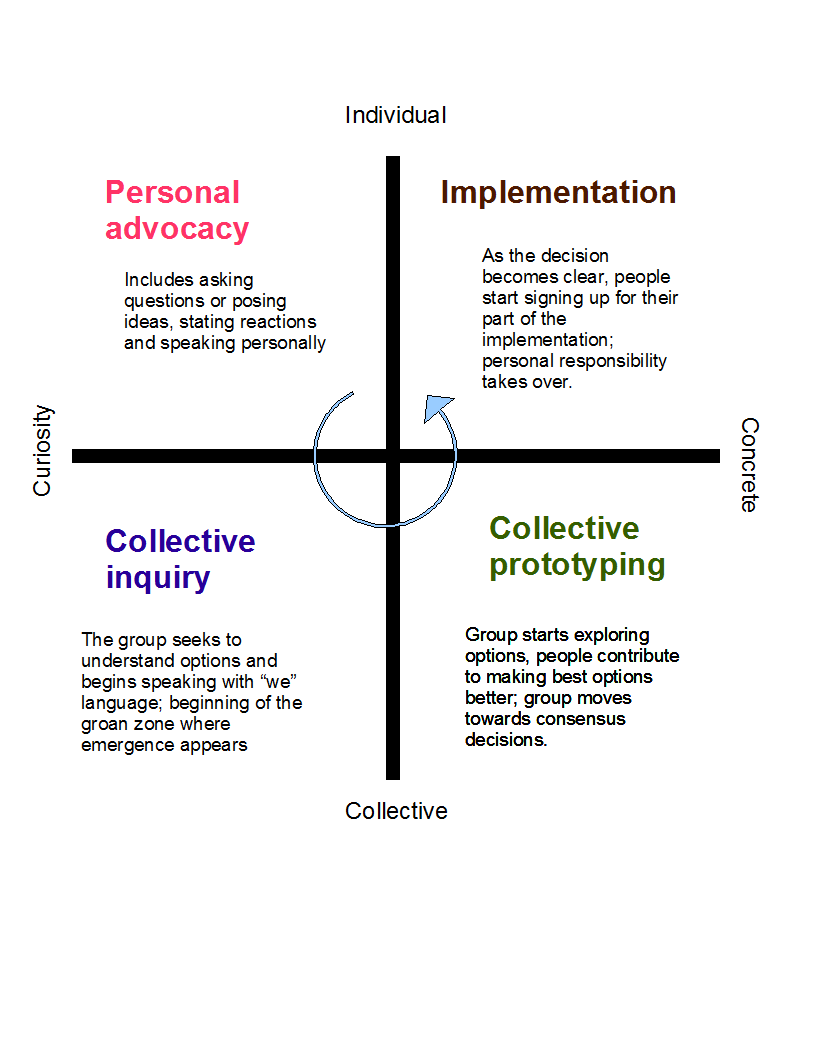
A while back I had been talking about social objects - the things that give us a reason to be in a relationship with others - and how they are critical elements in the process of social transformation. Now there's a kind of magic that takes place in that fuzzy area where we interact around that thing. What goes on there? And how does it lead to transformation?

Well, recently, there have been some interesting posts on the subject. First by Chris Corrigan and later by Dave Pollard that present a distillation of how this change takes place. Here's what they look like:

Chris Corrigan's Map:
And this, Dave Pollard's:
And it would seem that all this is based on something called the U-Process, developed by Otto Scharmer and friends. The U-process is a kind of framework for bringing about systemic change in all kinds of organisations and groups through a collective change process and is being applied here and there to try and tackle seemingly intractable problems. It looks something like this:

All of this makes good sense in the context of the process that we have been following in order to help Seva Mandir prepare its 6th Comprehensive plan, the meetings that we hold on a regular basis in Seva Mandir and the workshops that we have been organising with the citizen's of Delwara. For example, during the recent meeting with the women or with the 'harijans' (members of the lowest caste group, victims of great discrimination and exclusion) we have to get from a group of disparate individuals, potentially in conflict with each other, to a collective with a shared identity and a commitment to each other. In order to do this, we must travel from 'I' to 'we'. We need to open up our hearts to each other and contemplate what being together means. This is the bottom of the U. At this stage there is a sense of vibration within the group - of being connected to each other - both through minds and hearts ... and it is elevating. Once we reach this stage, translating the shared energy into concrete plans of action becomes much easier. But the process is not always either easy or smooth... and sometimes we are only partly there...

Two stages jump out as being the real critical points that need to be examined in greater depth. One is the shift into presencing. How does it happen? How long should it be sustained? The other is the taking of personal responsibility after presencing - the co-creating... How deep was the presencing? Did it hit the nail on the head? Did it cause the shift deeply enough to take the members to a whole new level? What would this take? Once we get back in our old system, out of the U-experience, we are back in those old positions, old routines, interacting with the same old people reinacting the same old patterns? Sure, if we can maintain our separateness through our newly formed group we may be able to maintain the energy... But high fall-out can be expected...

And, well, it struck me that this process is a kind of fractal - in the sense that it applies to large groups, small groups and well, why not, I suppose... Individuals? Now what would this look like at the individual level? One thing is clear: whether we are engaging in this kind of a U-process at the organisation or group level, we are dealing first and foremost with individuals.

What goes on in the individual during this process? And is there a way that an individual can experience this same transition from one state to another on their own? Is it necessarily a collective process? Is it only through my being and doing with others that I can bring about transformation in myself? If not, is meditation or reflection what this looks like at the personal level? Do I have to disconnect myself from my daily life in order to get there? Am I already there? Can I do this willingly? Can I presence perpetually? Is it more about a state of being?

And can this be done at the level of a community as a whole? What would be the method? How would we get a multitude of fragmented individuals and groups to gradually 'vibrate in harmony' as it were? What is the deepest collective presencing possible for a whole community and how do we get there?

I don't know what the answers are to any of these questions... but they do look like they matter!

And, I suppose, this is where the work that Seva Mandir really fits in. It can provide not just the U experience but it can also do the groundwork to prepare for entry and do the follow-up work to support what comes after. It not only gets people ready to dive in, it not only helps them to access the source, but it also provides support in enacting whatever comes next. Still though, ultimate responsibility lies in the hands of the people themselves. We give no instructions.

But the real question is how deep we get in the U process. This seems key to everything. If we get to the source, where would it take us? What would it take for us to get there? I think we cannot know the answer until we walk the path... And convincing anyone to embark on something that has no clear destination is not easy - although it seems more and more people are talking about this - facilitators, knowledge management experts, and more. But, wedged in all the entanglements of organisational reality - accountability, reports, targets, and the like - how do we do this (by Tom Atlee, hat tip to Dave Pollard)? The unknown or everything that we know (however bad it may be)? How do we prepare people for this kind of trade-off?

My mission in life, forgive me for this, is to facilitate a conscious evolutionary process. Yes, I read these words today on Tom Atlee's site, but I have known this (in these very words) as long back as 6 years ago. In order to do this I need to understand exactly how we connect to the source in the most effective manner to bring about the individual and collective shifts that are required, to harmonise humanity with the flow of nature and liberate the full potential of human spirit. For this I need to know how to get people, systems and everyone else on-board. How to connect people in this quest in the most effective manner. This is what I need to learn. And this is what I need to get from my studies.

Let's see where this road takes me ;)

Tuesday, August 26, 2008

the complan: where am i now?

An interesting time to write: I'm really supposed to be converting the last 6 months of dialogue, head-scratching, getting tired and worked up, writing on flip-charts, making presentations and so on into a single document that will: (a) communicate to donors what it is that Seva Mandir is planning to do for the next 3 years; and (b) serve as a reference point for Seva Mandir reminding it of the emerging directions and strategies that it has evolved. This document - the 6th Comprehensive Plan - is due in 6 days. But my mind, as ever in these moments, is filled with a multitude of other thoughts - not entirely off topic but off-topic enough to distract me from writing that document!

I think there are questions I have asked in the past that would be very suitable for picking up at this stage in time. Almost all of these questions relate to the process that we followed; to the changes that have taken place (or not); to my hopes and expectations as compared to what really happened; to what i can learn from the path that has been followed (including what I could have done differently - or would do differently next time); to try to identify patterns in the way decisions were taken and the process evolved (and looking at who had what role in that process, including myself); to think about what the blind-spots have been/are - both my own, of key individuals and in the organisation at large; to think of what I will work on when I return...

I have blogged earlier about some of the positive trends that have emerged as a result of the process, so I won't get into the details of the answers to all these questions now...

However, I do feel the need to express one of the feelings that emerges in response to all these questions. That feeling is that Seva Mandir has some blind spots in terms of the way it operationalises its understanding of complexity, power, organisation and learning - and this needs to be addressed. So long as these blind spots remain unresolved, some very critical problems will persist and continue to serve as a source of much pain and frustration for all those involved.

Writing up the Comprehensive Plan document while I can feel and see all of these things - perhaps all brought into stark relief as a result of the process that we have followed for the last 6 months - and not having the time to properly engage with any of these issues is like a kind of torture! However, it is helping me to cultivate that wisdom of the Tao.

It is also showing me, quite clearly, that the kind of process I undertook here was not able to get to the real depths of the issues and that an altogether different approach would probably be required. Interestingly, I feel that it would not necessarily be one that piggy-backs or is incorporated into a time-bound 'comprehensive plan' type planning process. It may well be that such a process contains within itself anti-learning elements. Therefore, the real change process will be one that systematically builds deeper and deeper learning into everything that the organisation does.

This, it seems to me, is really a quest for profound inter-personal truth and understanding. It is a spiritual quest and it cannot be packaged in a 6 month process. Though perhaps such a process can help us launch ourselves on such a trajectory... And it's just too early to really say whether this has happened yet or not... And so, life in limbo for Andre continues. Now I should really be getting back to writing the comprehensive plan!

Thursday, August 21, 2008

blind spots and collective evolution

A number of conversations and random readings over the last few days have really re-sensitised me to the need to understand the issues surrounding resistance to change... One idea that keeps on floating back is that change often seems to happen in spite of all the things that organisations do to prevent it. Change is about breaking patterns of behaviour or relationship that are by their very definition self-replicating, self-reinforcing. This is what creating novelty is all about. This is innovation. And a good reminder for an organisation working to bring about change in society is that it can only happen there if it is happening within us, within the organisation. We have to be in a state of creative, spontaneous change, always.

In order to do/be this we need to identify our blind spots – the systematic oversight that prevents us from seeing what it is that we are all doing that is obstructing us; the patterns of behaviour and thinking that prevent us from moving forward simply, creatively, harmoniously. These obstructive patterns emerge out of the simple interactions amongst us all every day. However, the process of their emergence is vastly complex – and that is one of the main reasons that they remain invisible to us. Understanding how the little, well-intentioned, self-righteous efforts we make every day add up to a vicious cycle that leads to stagnation at best and collapse at worst, seems critical. And that calls for a deep, collaborative inquiry into our very own selves; to know who and what we really are and to learn how to evolve, as both a collective and its individual members, in a more effective manner.

Thursday, August 7, 2008

the giant organic organisational learning cycle

A few posts back, I ended a status report on the 6thCP process with a question along the lines of:

is it normal to see or feel things happening as part of an organisational change process in a kind of staged manner?

Right now the answer looks like a glaring kind of a 'yes'. I got an insight into this today during what is probably the last big meeting of the preparatory phase of the 6thCP process. It was a good meeting, with a pro-active vibe and a good bit of laughter (despite an agenda that threatened to bore the living daylights out of people and to result in bruised buttocks).

In any case, i got my inkling while a discussion was going on about the newly created income generation cell, which I had sort of hoped would end up getting called a livelihood cell. The idea of calling it a 'livelihoods cell' appears to be more of my idea than anyone else's and, thus, it has not been given that name. Calling it a livelihood cell would carry certain implications for its functioning and its remit. Calling it an income generation cell seems more limited in scope. However, i held off from making a deal about this because I felt that there could be benefits derived from being more specific and focused here. This is what I foresaw:

Setting up a livelihood cell would bring together people from the different programmes. They would start talking about and trying to tackle large abstract issues and they would eventually have to narrow down their spectrum of issues to something achievable or manageable. Extensive discussions could take place around how NRD, GVK and WCD could perhaps work in a more effective manner together so as to encourage the emergence/support of more livelihood enhancing interventions/activities. However, the change would be distributed and may not have the potential to show solid results until deciding to shift onto the 'income generation' realm.

Setting up an income generation cell would also bring people together from the different programmes. It would start by trying to identify potential projects that could be taken up for achieving concrete results in terms of income generation activities for selected groups of individuals in different pockets. There would remain a disjoint between groups that were getting included and others that would get left behind. Questions would begin to emerge about how we broadbase what we have been learning. This would probably draw the cell to conduct a thorough inquiry into the efforts that it had made with different clusters/sectors and this would generate lessons learned that could be then taken up by the various programme units in a more systematic manner.

Both these stories are hypothetical, and the truth is that it could move in either direction. Clearly, this means I am in the 'complex' domain and probing will be the only way forward (for me, at this stage)... I feel that I am coming more to the conclusion that it won't make too big of a difference where the whole thing starts... If the team takes things seriously, has good quality conversations (and that isn't really just a little if!) and a fair dose of soul-searching it will gradually enable itself to do what it needs to do. In any case, I decided not to try and make noise about the livelihood issue - mainly because I couldn't decide whether it would really make a difference. It will be interesting to observe how the formation of the income-generation cell impacts on the rest of the organisation - especially the key programme units represented in it.

Anyway, the learning insight was this:
  • Take several similar units of inquiry and engage in a thorough action research process into them over a period of time that seems reasonable in relation to the timescale of the change that is being sought (hard to predict in advance really).
  • Then explore what worked, what didn't work and why, paying close attention to the way that particular factors (especially common factors) appear to have been influenced by context.
  • Use this to distill achievements, lessons, challenges, questions and principles that can be upscaled or mainstreamed
  • Repeat as required using new or existing units of inquiry as required
As I pondered this particular process later in the day, it struck me that this is a kind of archetypal action research process. Even a collaborative action inquiry would work the same way if the unit of inquiry is taken to be one of the collaborative individuals. It also seems like a kind of fractal pattern in the sense that it can be used on multiple scales, contexts and conditions. That makes it even more archetypal. Now if we could just see a little bit more evidence of this process being followed rigorously, with documentation that really goes in depth into how the change processes are taking place, I might just find myself starting to agree with Neelima about the idea that the whole organisation is one big action-research... Though I think I've said this before... that's not a little if :)

Peace!

Wednesday, July 16, 2008

half full or half empty... the muddle continues

It's way past my bedtime but I feel compelled to write. Failing to follow on from my last blog, this is a return to a lingering question of growingly nagging proportions: appreciative inquiry - is it a biased way of looking at things and does this make it somehow less useful or worthwhile in the broader endeavour to make positive change in the world?

This question first began to move beyond being a simple blot on my landscape to a kind of subject for inquiry after reading an article by Dave Snowden. A recent blog post by Dave Snowden got me thinking about this again. He wrote:
One of my real concerns here is the frequent conflation of Cognitive Edge methods with NLP and that other current popular method Appreciative Inquiry (AI). Now there is a big difference. My concern about AI is that it privileges one type of story over an other. Why should anyone tell people what type of stories they should tell? Despite my disagreements I can respect its practitioners and see that it has utility in constrained circumstances. [He then goes on to talk about NLP - for which he clearly has less respect than he does for AI]
So, the question that I am really grappling with is: in what contexts does applying Appreciative Inquiry makes sense? Or even better, where does the role of purpose fit in to the whole practice of story-work?

It seems that Dave's approach is concerned with eliminating any kind of bias into the 'inquiry' or story-eliciting process. Now, I may be just fuddling my way through, but it seems to me that any process of gathering stories will need to have some kind of a purpose (am I missing something?) - whether it is simply to generate a database of contextualised organisational happenings from diverse perspectives (why would we want this) to something more overt like enabling an organisation to become more effective at what it does (e.g. by becoming more responsive to its clients needs, learning more effectively, improving leadership and communication patterns, etc.).

I recognise that I may have the wrong end of the stick (please point this out if I do). I also recognise that the very process of surfacing a question or purpose for 'inquiry' itself may require an inquiry in its own right... But even this sense that 'something needs to be done' will be informed by some kind of nagging notion that... well, there is something that needs to be done... about something!? Hmmm...

But Dave's critique focuses not so much on the subject or purpose as the 'type of story' - i.e. in the case of AI, this would be the story of what worked and what were the conditions that led to this thing actually working - a positive take. I suppose, the point is that it makes good sense to look at what isn't working and how things end up not working -because this might tell us what we ought to avoid doing.

In various articles of Dave's that I have read, he talks about using the story of the chap who discovered that latitude could be calculated simply by using a clock as a way of getting people to feel comfortable about telling stories of times when good ideas were scrapped because of bosses with old-paradigm world-views... Now isn't this as much an attempt at telling people what kind of story to tell as doing an AI would be?

So is the point that we should ask people to tell all kinds of stories - the good, the bad and the ugly? How do we decide how we should lead the questions? It seems that we have to elicit a certain type of story - at least in a number of situations - in order to get at the juiciest bits which may not respond to a simple question like 'tell me about leadership in the organisation' - it just seems way too vague - and therefore liable to elicit a vague series of answers that have to be gradually probed to get to the depth by gradually making it more specific (e.g. by using the latitude example).

The other tendency that I have observed is that people love talking about negative stories. Huge amounts of staff time go into ranting about problems, complaining about things, etc. My sense is that this tends to breed a negative mindset and can be very counterproductive. Just imagine if some more of this time was spent by people having constructive conversations about how to solve problems, or for sharing knowledge and experience, coming up with new initiatives and so on... Now wouldn't this lead to a dramatic increase in effectiveness? Perhaps I am completely missing the point!? What if bosses could listen to stories about times when their staff had really felt able to perform and deliver change?

In the end, I suppose that both the positives and the negatives are essential. It seems to be as important to know what we can do as it does to know what we shouldn't do. But when we are on the move, and we don't have vast resources to put in place high end knowledge management systems (as in the case of the NGO where I am working in India), might not an AI allow us to get rather a lot done - even if only in such constrained circumstances?

In any case, I have resolved to take this question with me into my practice and really have a go at unearthing all manner of stories - positive and negative - with the hope that I can begin to get a sense for what all of this adds up to...

Friday, July 11, 2008

Trying to get some bearings...

It's been a while since I managed to get back to the blog and I have a lot to say. At the same time, I really want to learn how to say whatever I am trying to say in less space. One approach could be to use several smaller blog postings (to create the illusion of using less space). Another is to try and use visual media (to really use less space). I think I will use a combination of the two.

In any case, here are the main things on my mind that I want to blog about a little bit more (though not in any particular order) in the coming days:
  1. How most communication takes place (and why)
  2. How this leads to the mess we're in (and why)
  3. What getting out of it might involve (and why)
  4. The place for spirituality in all this (and why)
All of these seem to be connected to each other - within myself at least. Making sense of this all will be an important part of my own learning journey. All this is inspired by various things I have experienced and read over the last couple of months, including:
  1. Re-visiting my early reflections on Action Science
  2. Reading Dave Snowden's work on stories and complexity
  3. My recent engagement with anthropology
  4. Reading the Katha Upanishad and the Tao Te Ching
  5. Facilitating communication between a volunteer and organisational staff
  6. Witnessing various conflicts within my 'home' and within the organisation
  7. Late night and other engaging discussions with friends on much of the above
  8. A good bit of improvised fictional story-circle
  9. Some reflections on stepping out into the unknown and how this makes me feel
Let's see how this unfolds.

Wednesday, July 2, 2008

Full Circle? Maybe more of a spiral!

Today, I am reminded of a dream I had when I first joined this organisation. I entered a room, lit by sunlight and decorated with potted plants. In the room there were a series of low tables (of the coffee table kind) with chairs around them. People were sitting around these tables engaged in conversation. The people were from all the different units in the organisation and they were excitedly and passionately sharing their ideas. The air was ripe with inspiration...

An odd dream, I suppose (it's not made up, honestly!)... Clearly a sign that I am obsessive! But today, having completed my first Appreciative Inquiry (at least the first part of it), having discovered World Cafe, Open Space and the Art of Hosting, having come across the work of people like Dave Snowden and Shawn Callahan of Anecdote, and having discovered all this gigantic world of story-telling and meaningful conversations, I feel a little like I am coming home. Is this the reason why I came here (here being this 40 year old organisation in Udaipur, Rajasthan with whom I am presently associated)?

The reason I came here, and stayed on, was simple: I wanted to make a 'sustainable contribution'. The more I worked, the more I learned about people, systems, organisational learning, systems dynamics and complexity theory, the more I came to understand what this 'sustainable change' really meant and what it might take to bring it about.

The more I think about it, the more i realise that the deep change will take place when the patterns of conversation within the organisation change. And changing the patterns of conversation within the organisation is, by and large (not meaning to sound overly naieve), a matter of opening spaces for conversations and asking the right questions to get the right kind of conversations. And the message that I am getting now, after reading and listening to all kinds of things on the subject, is that stories need to be the basis of this conversations.

Of course, the conversations can build on, manipulate, deconstruct, reconstruct and distill the stories in myriad ways - all guided, of course, by matters of purpose (why these stories?) and context... But those stories are the foundation of any learning and change that is going to emerge. They are the raw data for creating meaning collectively. Story, it seems to me, only really has significance, only really comes to life, in an inter-personal setting.

I have been using anecdotes throughout my time here at a personal level to explain or justify things. Not very effectively though! For the most part, I seem to have used them almost accidentally - not as the foundation of a carefully considered way of generating deeper understanding. Now I feel that a whole new universe has opened up before me based on story-telling. It is as though the entire organisation just dissolved into its basic unit: stories.

The story has the potential to connect the women's group leader who isn't getting the support she needs to the chief executive in a way that a target (30 women's group leaders trained) doesn't. It can also connect the health in-charge to the education in-charge through the story of the child in the community school who got ill and none of his friends had basic first-aid knowledge. (By the way, I just made these stories up... to prove a point).

Another realisation, and one that came just now, is that the real pressing need - to complete the learning cycle - is to link the stories of the villagers themselves (the local leaders, the users of the irrigation system, the trained birth assistants, the children in the community schools) to the stories of the field workers and to link the stories of the field workers to the stories of the block staff and the stories of the block staff to the unit staff and the executive committee and beyond.

Now I may be obsessing a little. But for an oral culture, of which Mewar (the region I am living in), I do believe, is a fine example (though it has its writing too), story telling should be a piece of pie as natural as herding goats or collecting berries from the forest! All we need to do now is navigate the donors and their out-dated obsession with de-contextualised numbers that drain time and energy away from meaningful, inspiring, change-inducing conversations based on stories!

This is all, perhaps, a gross simplification of what will probably take a lot of perseverance and (self-)mastery to apply. And I by no means intend to do injustice to story-work. But I feel I have just reached a new level in my understanding of something of great importance.

The excitement of the adventure continues! Or, rather, begins (again, only more so)!

Friday, June 27, 2008

Digging the Narrative Approach to Civic Driven Change

I couldn't help myself, to be honest. The opportunity to participate in the dialogue on civic driven change in Jaipur organised jointly by Context, International Cooperation (a Netherlands based social enterprise/consultancy) and CECOEDECON (a 25-year young Jaipur-based NGO), especially getting to spend some time bantering with Fons and his friends/fellow-travellers was just too good to miss... Especially as the subject seemed to be a wedding of two subjects that I am passionate about: social change (of the civic driven variety) and complexity theory.

Admittedly, I was a little confused about the purpose of the gathering (as in what we hoped to get out of our discussion on these two subjects), and I also felt that I would have appreciated more time and space for genuine dialogue on the subjects raised rather than what turned out to be a rather linear (admittedly it was a circle) exchange of views (funny, considering all the concern with social change itself being a non-linear process!)... But there were great time constraints and I had the good fortune of sitting in the debriefing group at the end, where there was more space for this kind of an interaction.

Overall, what was most meaningful for me? I think, it is the insights I got into the following questions (which is also, I realise now, a reflection of my what questions I was carrying with me):
  • Why does a complexity perspective mean that should we look at ourselves as explorers rather than experts or traditional researchers? And how do we go about our exploration? Why is it important to do so in a collaborative manner?
  • What would a large scale, multi-stakeholder collaborative action research - with the objective of understanding how civic driven change actually happens - look like and how would it operate?
  • How I should deal with the ugly thing we know as the logical framework (LFA) in the coming 6th Comprehensive Plan and what kind of meaningful, participatory, qualitative-focused learning systems could be used to compensate for the horrible void that is the LFA?
  • What is the potential for taking up the strengthening of the inter-organisational platform for civil society learning and self-governance at the Udaipur level? How should I get started and who can I to talk to for this (thanks to Pradeep and Marieke)?
I'm leaving them all as questions because what I have gained is a bit more insight than clear answers. But all rather encouraging.

An interesting opportunity has also emerged for Seva Mandir to work with Fons and Co on the narrative based collaborative action research on civic driven change, including - but not limited to - child-centred change. It also seems to reverberate with conversations we have been having within Seva Mandir on the topic of distilling our own understanding of the change process (including the one we had during the annual camp) and our oft repeated pride in being an organisation that learns from and builds its knowledge based on experience!

Some questions, however, that I'm still not totally comfortable with are the following:

To what extent and what kind of NGO intervention can still permit us to call what happens as Civic Driven? For example, if Seva Mandir initiates a dialogue, makes available certain resources and provides facilitation inputs as a result of which citizens begin to organise themselves around certain resources, issues, commons and values - does this count as civic driven change? Where is that fine line between civic driven and not civic driven change (or perhaps we'd be better off talking about a gradient from totally self-organised civic driven on the one side to coordinated with some civic participation on the other)? It seems to me that the nature of the change that we talk about has some pretty serious implications and this need to be unpacked.

In any case, the wonderful company and conversations at dinner provided a great end to a very interesting day! So thanks to all for making it possible!

Post Delwara Realisations

A view of Delwara's roofscape at sunrise while having morning chai at the house of the former Secretary of the Citizens' Development Forum

Today, sitting in Jaipur airport, on my way back from a fantastic day with Fons and team (to be discussed in more detail in the forthcoming post), I find myself remembering Delwara.

I'm not really a believer in regrets. I much prefer the idea of learning from the past in a positive, constructive way rather than dwelling in past failings or shortcomings. Having said this, I will permit myself a couple of backward looking thoughts in the context of Delwara.

First, I wish I had known about blogging while I was in Delwara. I kept a diary in an almost fanatical manner during my time there and was also working on putting together a website. If only I had thought of putting together a blog I could have killed more birds with one stone than you could shake a stick at (not that I am in favour of killing birds with stones). Based on this realisation, I have taken a vow to cover any project that I have the good or bad fortune of embarking on through blogging. It will be my tribute to the world and all the people who are part of my efforts.

Second, I wish I had not been (a) so arrogant; and (b) so confused about my role. Of course, there is nothing I could have done about it at the time - because that's probably where I was at as a person... But if I hadn't been so fixed on doing something related to Planning Monitoring and Evaluation - and more specifically Outcome Mapping - at the outset, I might have been better able to really engage in the change process.

I feel that I placed all kinds of barriers on my role and didn't quite manage to do what Ajay had advocated (going about and having meaningful conversations) - which, to be honest, seemed far too unfocused for me at the time... and my understanding was that more than anything, the project needed a fancy, participatory visioning and M&E kind of a process (which it did but not at that point)... Admittedly, I did manage quite a bit of what Ajay suggested, but still... far too bounded by my own thoughts. Easy to say in retrospect, I suppose.

Finally, I thought it would be good to include a link to a paper (soon to be published) that I prepared based on my experience in Delwara. Although it is rather long, and doesn't quite capture the full richness of what has taken place there (there are hundreds of good stories of change from Delwara), I feel that it distills the essence of the change process. It also offers what I believe may be some important insights in the context of the bigger debate on 'good governance'. Here are some snippets...

[...] this paper calls for a more culturally grounded understanding of the role of participation in the development of complex societies and is concerned as much with the value of participation in securing immediate instrumental objectives as in transforming the way that a fragmented citizenry relates to itself.

[...] it is critical to recognize that the Panchayat, at the local level, is a culturally embedded system and that its status is, by and large, a reflection of the society from which it is constituted. It is, therefore, only to be expected that an unaware, fragmented citizenry, deeply embroiled in conflicts of interest, mistrust, etc. will not be able to elect a Panchayat that is able to function in a democratic, transparent, accountable – or, for that matter, even remotely effective – manner. Nor will they be able to make or hold it accountable to themselves or to the village as a whole.

[...] the experience to date in Delwara indicates that when the starting point is a highly diverse and fragmented citizenry, establishing participatory governance systems is primarily a challenge of (i) enabling citizens to engage in processes of self-transformation; and (ii) enabling citizens to form relationships of mutual empowerment amongst themselves. To achieve this involves creating spaces and processes that support this transformation by bringing together citizens of diverse backgrounds in an organisational culture that embodies values of equality, dignity, respect, compassion, transparency, democratic deliberation, inclusiveness, collective strength and learning together.

An organized, cohesive and empowered community is far better placed to collaborate with and leverage the resources of the Panchayat than a fragmented citizenry. This means that the idea of responsible citizenship is about a great deal more than mobilizing people to demand resources from the state. It is, instead, about engaging people in a process where they have to confront themselves – both as individuals and as members of a social group. [...] Differences in ideology, values, worldviews, class, gender, geographical location - all provide pretexts for accentuating or shaping conflicts over decision-making processes. These conflicts have to be surfaced and [collectively] deconstructed in order for positive change to occur.

I will be thinking of ways to do justice to the Delwara experience in the coming months...

Thursday, June 26, 2008

...indeed, the journey's only just begun!

This appreciative inquiry thing is rather interesting. Although I had the sense that I wasn't quite managing to do what I ought to be doing, I think that I somehow managed to pull loose ends together and tie them up with a neat little bow. Thanks are due to the appreciative commons through which various ideas about how to present what had come out were made available. The feedback I have gotten so far on the appreciative inquiry and the presentation I made based on it, has been, for the most-part, very positive. Not only the (verbal) feedback though… People seem to have a little bit more spring in their step - though of course its far too early to tell whether (a) this is just because of my own perception; and (b) it is going to last.

In any case, some reflections. First, although I obsessed about what I was doing, it seemed a little bit too easy. It seemed as though I didn't have to do anything. Now, this is also nonsense - because I was working until midnight for several days during the run-up to the annual camp… But that was also due to other reasons.

Once the data had come in and once we had done our group work of analysing the data and converting it into themes and values with their quotes and stories to back them up, it was just a matter of figuring out the provocative propositions. I feel that I didn't do this properly. Somehow, it seemed to be too much a matter of me just piecing the statements together, one after the other… Yes, I did spend a night in the office with some of my workgroup looking at these statements but the word-smithing was mostly me… and that felt like a problem at the time.

Anyway, the first time it got air-space was at the meeting of the sanchalak mandal (the executive committee) meeting - the day before the camp was due to start. It was generally appreciated but there were some tensions and questions: the expected ones - where is the negative stuff? Why focus just on the positive? But you haven’t told us how we are performing in relation to these values (which I very, very clearly stated was in no way my objective whatsoever)? And all the associated points that back up the idea of dwelling on problems… (and the image - shown above - taken from Yes!andSpace (hat tip) didn't seem to help so much as aggravate the idea that things were one-sided, too positive… it triggered the response: "if we only focus on the positive and future things, we are not learning from history - so we will end up just repeating past mistakes" - which indicates that the whole concept of the appreciative inquiry had not been properly digested by the audience).

I tried an array of methods for explaining the principle and ended up using the kind of analogy that I don't usually feel comfortable using in front of people in high posts (because I worry that they will be degrading). I said: "If I want to know how to get to Delhi from here and you tell me - 'don't go to Ahmedabad, don't go to Kota, don't go to Jaisalmer, don't go to Bhopal' and so on it doesn’t really make it much easier for me. However, if you tell me - 'this is the road to Delhi' then I can set off along it more easily and with greater confidence." Which seemed to work a little - though I didn't ask for feedback to confirm this.

Anyway, I conceded enough on the basis of our discussions to incorporate a question that would give people the space to talk about what Mustafa (on of the structure consultants) called 'the shadow behind the values'… And this was a very interesting part of the whole event for me. Things were happening fast, there were pots and pans banging in the background (so it was necessary to make quite a lot of effort just to hear each other) and we'd just eaten ice-cream (which was very nice indeed). Everyone had just been sitting in the presentation looking and listening (to varying extents). And now we had to talk about performance in relation to the values.

It took almost one hour to get the group to move out of the comfortable silence on the topic of where we were failing to live the values. It took coaxing. It took trust-building, no doubt made more difficult by the presence of Sachin - a representative from PLAN who funds us. To get around this I eventually got the bright idea of getting Sachin to share his own experiences from PLAN. When it came up that they've been having their own challenges (all organisations do y'know!) people got a little bit more open.

After wrestling with conceptual clarity and getting over the fact that it isn't easy to talk about these things - especially as they may be personal, we got into a fairly heated discussion about the values. Some individuals became a little bit too garam and had to get up and cool off. Others sat cold as stones. Various stories came up of ways that leadership had not been sensitive, ways that the organisational system wasn't supporting workers' contribution to change, ways that there wasn't openness (of which the one hour it took to open up was the most striking example)…

The energy was fairly tense. I was doing some fairly active facilitation - though I can't recall many of the specifics - but almost as much energy as went into opening the discussion to the deep dark well of 'what ain't right' went into trying to pull the group back out to the world of 'what we gotta do then'… Eventually we did this and ended up with some suggestions that we then pooled with four other groups who had been talking on the same subject. We were able to compile together from across the various groups into a presentation that pretty much captured everything that need to be captured. This got presented the following morning and seemed to go down relatively well… This is basically what it recommended at the end:

How to take the values forward:
  • Start with yourself: be the change that you want to see
  • Use the values as a basis for staff performance evaluation
  • Create time and space for dialogue on these values amongst staff
  • Improve organisational systems so that they support the practice of these values
  • Establish a system for grievance redressal involving staff from all levels of the organisation
  • Take this conversation forwards
I suppose this means we are at least thinking in the right direction…? Of course, there's a lot more fleshing out to be done... Given the discussion we had the following day (mentioned at the end of my last post), I suppose, means that we are actually doing something about it all? And to think this is only the beginning!

One of my lingering questions though... was the negative patch useful and important? Did it add or subtract from the discussions we had? This is something I will need to ponder on and explore as I continue on my adventures!

Friday, June 13, 2008

Teetering toward the big day

Today I read a brilliant harvest of a workshop in which a diverse group of people tackled the question of how they could move towards a 'Person Centred Culture'. As I scanned through the material, I found myself deeply inspired and connected with what came out. I will not try to paraphrase it but you can read the whole article here.

Over here in Seva Mandir we are engaged in the preparation of our 6th Comprehensive Plan. One important part of this is exploring our oragnisational culture. The discovery and dream phases of our Appreciative Inquiry have now pretty much reached completion. A small group of us will sit together next week and try to craft the 'provocative propositions' (statements about what the ideal organisation would be like based on what people have been surfacing). The plan is that when we get to the annual retreat (coming up in about 9 days - horribly close by!) we will present the major findings of our appreciative inquiry along with the provocative propositions.

These provocative propositions will then provide the basis for group discussions. The group discussions will have a set of guiding questions that aim to take the group from understanding what it (the provocative proposition) actually means (from diverse perspectives) to figuring out what concrete steps can be made at individual and organisational levels to make it real. After the group work, people will be able to take a break and reflect, go for a walk or chat with their colleagues... Then dinner and some relaxation.

The following morning the groups will present what they have come up with on each of the identified themes. And then we will see what we have got on our plate :) I am still not completely sure about how this is going to work and I have half a dozen naggling concerns to deal with. Is this all too pre-planned and do we need to build in more space for open topics (a la open space)? How will the little groups be facilitated and what preparation will be required for this? Will there be overall support for the process and what is coming out of it?

I realise that we can't do everything with the limited time we have... So more than anything, this is going to be about securing the optimal usage of our time - having contributions that lead us further in the right direction. And like I've mentioned before, this is my first time... ;)

What do I do?

It just struck me today, right now, as I was walking down the corridor to respond to nature's call, that my work can be divided into three broad categories:

One. The work that I do directly for the organisation that is necessary (mainly from the organisation's point of view), routine and somewhat tedious - for example, writing progress or annual reports. I have an inbuilt resistance to actually doing this kind of work that I have to struggle against in order to get things done on time. Sometimes it actually hurts me to do these kinds of things. I still find myself unable to say no.

Two. The work that I do directly for the organisation that is necessary (more from my point of view), non-routine and in-line with my own passion - for example, facilitating group discussions on vision, strategies, organisational change, monitoring and evalaution, action research, participation, etc. Though I am not yet so great at this, I pine for opportunities to do this kind of work and struggle to create the space to do this in the way that I want, based on the principles that I either believe in or am trying to learn about.

Three. The work that I do primarily for myself, for my own learning and personal development - for example, reading articles, blogs and emails, writing my own blog or in my diary, posting comments on discussion forums and mailing lists, doing some meditation or reflection... and so on. This work fills me with satisfaction but has the danger of making me narcissistic or self-obsessed and tends to stop me from focusing properly on one. It does, however, have the fortunate advantage of helping me understand myself better.

Obtaining balance between these elements seems to be key. My service to the organisation (one) opens up a space for me to do what I am passionate about (two) - which (as far as I am concerned) is more of a service to not just the organisation but the world in general - and is, therefore, very important. On the basis of my experiences in two, I have a basis and grounding for my personal learning and development (three), which also helps me become more effective in two. Three, therefore, is integral to two and is also very, very important.

I remember someone, somewhere, talking about something called 'a social life'. As I struggle to retain a happy balance between one, two and three, I am still trying to figure out where and how this 'social life' thing fits in to my schema! That must be the bit where I go home and eat food with my house-mates, chat nonsense, jump about, have a beer and make silly jokes. And what, exactly does all that contribute to?

Tuesday, June 10, 2008

The (premature) tribulations of an uninitiated but aspiring mid-wife

Yesterday was the last-but-one meeting of our Appreciative Inquiry work group. The idea was that over the last few months a group of 12 people had been busy running about the organisation having conversations with people about such things as: "... a time when you feel you were really able to contribute to bringing about change...", or "... what you like best about the organisation and why"... and so on. Before the meeting I was, admittedly, a little bit nervous. What would I find? What would people have gathered? How many surveys would have been carried out? How representative would they be? Would the material be really useful? How on earth would we analyse and then present the output of a gigantic stack of interviews?

It is at this point that I humbly acknowledged that there is a great deal about the way I have handled this work over the course of the last few months that I would do very differently if given the chance. Easy to mumble this to myself in retrospect, of course - but that doesn't make it any less present right now. I would have tried to be more organised, sending out letters informing people what was going on instead of relying on word of mouth. I would have printed out lists of names for each of the people in my team to interview and tried to set fortnightly targets to avoid the last minute rush. I might even have explained the entire concept a little differently... But then it's not as though I hadn't thought about all these things... I just didn't do them... and I did have my reasons too...

So, before heading off to my meeting, I prepared what I considered to be a clever little meeting-plan that I thought might just do the trick. After going through the formalities (basically checking that at least 25% of the organisation had been conversed with) I would give a spiel in which I re-explained the purpose of all these conversations from a slightly different vantage point - one that I felt would gear people up to dig through their experiences, accept diversity and complexity and move, pretty rapidly, towards getting us some provocative propositions. After this (and making sure that I didn't drone on for more than 5-10 minutes), people would split into groups and start sharing, verbally, their experiences from the conversations, at four levels:

First, sharing of the stories, experiences or perspectives from the conversations that were most inspiring, most powerful. Second, identifying the various themes that seemed to be surfacing again and again. Third, culling out underlying values and principles that these pinnacles were founded on. Fourth, selecting quotes that communicated some of these complex ideas in very few words. And I got to spend this time sitting in silence. Then a break for lunch. Then the sharing.

The sharing is when things started getting really interesting (for me). The first part proceeded quite smoothly as the first group shared its points. There was a little discussion - mostly for the purpose of clarification - and I was primarily occupied with note-taking (which I did quite thoroughly thank you very much!). The second group then got busy with its sharing. This time, people were a little bit more eager to pipe up and share some of their own views in this context... Perhaps the sitting and listening during the first group's presentation had made them feel itchy?

Up until then, things had proceeded smoothly, there was only minor evidence of tension or emotional strain. Now, however, things got a little different as the discussion started to acquire a direction, tone and life of its own. It appeared that somehow, the discussion had got latched onto a personal issue of one of the group members. It was not long before the platform had started turning into a space for people to vent their frustration. For some reason I only seem to have managed to realise what was happening until it was a little late. The droning of the construction work going on outside was certainly not of much help!

Eventually, I managed to get us out of our ugly little rut by explaining that the issue was not getting neglected since the underlying positive principle had been duly noted by me and that we were running out of time a little and couldn't possible handle dealing with every individual worker's issues during the annual camp since (simple maths: we have 250 staff and three hours)... This led to a little bit of thinking and I got some good support from one of the most senior staff member present who explained that what we were doing could be looked at rather as (a) finding out what's best; and (b) giving suggestions of how what isn't best could become best... rather than simply pretending that everything is ok. It seemed to work. There was a pause.

I then shared a lesson I had once learned - it was about apologising. Apologies have secured me a great deal of internal peace when deep inside I have been furious. I think I have asked for apologies from just about (though not absolutely) everyone that I have entered into some kind of a conflict with. My asking for apologies is as much about me forgiving them as it is about me wanting them to forgive me... somehow asking for apologies entails a kind of general spiritual release on all sides and makes life much more bearable - certainly a great deal easier than having an ego throbbing in my chest, throat and brain and brutally suffocating what little of the divine might exist within me! There was a silence. Then I mentioned that sometimes tears would come to my eyes when I asked for apologies. There was more silence. Someone said what I had been thinking: "that's because you have to deal with your ego." There was some more silence.

I broke the silence. I wondered immediately afterwards if that was a mistake. Silences can be very good. Especially the meaningful ones. They can be better than words, I believe. But I ended it and we moved on with our work. It was getting late in the evening and some people had a long way to travel home and we were really running out of time. So we finished off with some formalities. A core team was formed to assist me in figuring out how we would get all the material that had come out into a meaningful presentation... and then I went home.

At the end of it all, later that evening, I found myself thinking. I imagined the proceedings of the camp,: groups of people sitting in circles and discussing Seva Mandir's burning issues; sharing perspectives; listening to and learning from each other; coming up with ways of creating a new organisational reality based on the emerging visions... It was really like a dream (the one I've been having for the last three years or so) - to early to say come true - but definitely imminent.

But how would I facilitate it? There would be at least 12 groups of as any as 20 people each. There is no way that I could be everywhere at once. What if someone starts ranting or getting upset? What if a cascade of grievances start to emerge? How could I get the genie back into the lamp? And then a whole load of other questions started emerging: what if management doesn't back our findings (this has been a latent, hanging around kind of a fear)? Do we have the right kind of data? Will they be picking holes in our methods? Will they challenge our 'objectivity' or question that we are not a representative sample of the oragnisation? Will they say that we have just been fed nonsense or been conned by simple, self-interested people in the organisation?

And that's the point where I wondered whether I hadn't chewed off more than I can swallow. I set myself up for something really rather big. I can imagine that for some management consultants this seems like a splash in a baby's paddling pool... but to me, this feels very much like the deep end. As I try not to drown in the multiple other commitments that I have - the organisation's annual report - things related to Delwara - I will need to pray for balance, strength and courage. There is a whole new world out there, waiting to be born. I feel like I am the mid-wife, about to conduct my first delivery, with no formal training, with no clear mentor - only concerned family members watching. And it's not just any old baby: it might just be the next messiah!

Now that is food for thought! I need to get myself ready!