N.B. This piece has been taken from my reflective writing journal and should be understood as tentative and incomplete :)
It seems that we are all here in order to make sense of things. We look into books, we look into each other, searching for what is out there, what is right - and maybe also, who we are. Each of these is important. But it is often the last that is most neglected.
What we need now, is healing. Healing at so many levels. We need to reconcile our divergent worldviews, our pain, our joys and our shared destiny. We cannot exist the one without the other. The suffering that we continue to inflict upon our own family by thinking that we know best, that we have the answer, that it is this way not that way is causing such rotten damage that we are, in effect both the poisoner and the poisoned. The question before all of us now is how we can escape from this vicious cycle of harming others and harming ourselves. Where does the healing begin?
When I was working in a small town in India I became sensitised to the fragmentation that was all around me. The town where I have been working was populated by around 5,000 people belonging to over 25 identity groups - Hindus (over 20 castes), Jains, Muslims, tribals. That each community has its own neighbourhood - to this I am not opposed. However, that they should be pitted against each other? That they should be positioned in a hierarchical structure which exploits and results in suffering and pain? That politics and religion should be combined as a means to lash out, prevent progress or spread disharmony? That I cannot accept or tolerate - and am open and honest that this is where I am coming from - even if this makes me culturally insensitive! But then I ask, "What happened to vasudev kutumbh?" Where and when was that idea thrown out to rot? By whom? And how dig must the people of this planet dig into their souls to rediscover it?
So where does this loss take us? Youngsters - merely 10 years old will insult each other on the basis of their identity: Hindu dog! Muslim pig-fucker! For these youngsters it can be funny - or perhaps even grown-up seeming to engage in a testosterone, power-display with each other. But this is no small joke. When the right wing Hindu-ist BJP party stirred up a conflicy between the Tribals and the Muslims, threatening to destabilise an age-old and peaceful co-existence over something that was strictly a matter for the Tribals and Muslims to resolve amongst themselves rather than politicising it! I felt a great deal of fear at that time. Perhaps because I knew that we, as the implementers, had created the opening for such opportunistic communalism through our activities. It was not the first time we had done so either. I learned: never, never, never fail to do the communal calculations in any community development work. Make it an explicit part of the considerations of what is being done and make as sure as you can that you have left no little stone unturned. But how do we become immaculate? Not just as individuals able to be mid-wives to new and more harmonious realities, but as a collective; as an organisation?
So these little tensions erupt now and again. Perhaps that is a necessary or inevitable feature of what is, more or less, a state of peaceful co-existence. I would ask: where do we decide to place the bar of what wrong-doing we are ready to tolerate? How much pain and injustice can we tolerate? Can we really tolerate any? What are the world and its many people calling out for? Clamouring for?
Which takes me to the old man I met in the Muslim Mohalla. We sat down to have a group meeting. To talk about the new water tank that was being proposed and for me to get a chance to meet some of the people that I would be living with for the next year and a half. An old man, with greying hair, a weathered face and wearing dark-grey shirt and pajamas came toward me and slowly squatted down onto his haunches. I greeted him: "Salam alaykum!" "Alaykum Salam!" he replied. I asked him how he was. He asked "What can I answer?" I asked him what did he mean? He told me of his family. A broken family. Sons that didn't speak to him. It was heart wrenching to come close to understanding how he felt. The world was not like it used to be. Children used to respect their parents. Now all they wanted was to be free. To be apart. There was deep loneliness and pain emanating from the old man. And I said, "I'm sorry. I understand what you are saying."
And then there was the lady from the Meghwal community who burst into tears while one of our volunteers was out investigating the relationship between women and water in her community. After a semi-structured interview, in which a local youth (one of our hero's) was helping out as a translator, the woman began to cry. The questions had been probing the problems faced by women in collection and management of water and the idea was that some of these discussions would help to highlight some of the usually unspoken issues faced by the women. The volunteer and the local youth asked the woman what the matter was: "In all my life, my own sons have never asked me how I felt! Never asked me what difficulties I faced! Never offered to help me fetch the water! Never asked me what could be done. Today you two people, not of my own family are the first to ask me such a question!" So much pain - would it have ever surfaced without those questions.
So the fragmentation - that we see on the news at the international level, that we see in our big cities, that we see in our small towns, that we see in our communities, that we see in our families - how deep down does this fragmentation permeate? I have come to locate it within the individual. I am fragmented, you are fragmented he/she is fragmented. Our minds are fragmented. Our souls are fragmented. We are full of contradictions. Our very process of perceiving is, the vast majority of the time, is fragmentary in nature. Our relationships with everything around us rise up out of us, connect to that which is around us, and feed back into us. Just like a loop. On the one hand we see ourselves as victims of the outer world. But why do we not also see ourselves as victims of the inner world? Why do we not see that it is our own way of being in the world that we have control over? That it is the harmony that we can cultivate within ourselves that will enable us to bring harmony into the outer world?
And this is why I believe that what we need now is healing and not 'development'. If we were to focus our collective energies on healing the people, healing the families, the communities, the Tribes, what would be the need for anyone to 'do' development? If people were living in harmony, helping each other to live; co-existing, co-learning and co-creating, then what would be the need for projects and institutions? We need to redefine what we call a vibrant economy. We need to redefine what we call politics. We need to redefine our very own selves and become part of a living process in which there are not people doing things to other people; only people doing things, for each other, together.
This line of reasoning led me to wonder. Could we have created the world we have today, with its various crises, without injustice. Injustice is what has enabled us to produce this mess. And it is the ceaseless denial of injustice that allows us to perpetuate it. But how does one remove injustice? What is the process to be followed? Yesterday I watched a movie about samurai. In it one of them said: you cannot kill the weeds that choke the flowers by poisoning them, for you will then kill the flowers too. But you can plant flowers that draw their energy from the weeds, causing them to wither and vanish. Does this work for our approach? It makes me think of appreciative inquiry!
Showing posts with label community development. Show all posts
Showing posts with label community development. Show all posts
Thursday, October 30, 2008

Sunday, October 12, 2008
Back to school!
After 5 years of living in the 'wilderness', of gathering experience and of learning from the immediate reality, I am finally back to 'school'. School, in this case, is the Institute of Development Studies located at Sussex University. My course, for those who don't yet know, is the MA in Participation Power and Social Change. I have blogged earlier about the questions I had on whether to go back to school? so I won't give more of that here... Instead, my take on what I've experienced so far.
Firstly, I have no regrets about coming here. It is proving to be everything I could have hoped for and more.
Academically, we've had a very light first week. Most of the time has gone into dealing with all of the formalities and getting us introduced to our courses. More importantly, than this, though, it has focused on getting us to know each other. For example, Robert Chambers' (of PRA fame) introductory workshop enabled us to meet all the 130 or so students, break the ice and lay the foundations for a real state of community! The sheer diversity that is present is something to be happy about - and not just nationality but background, past employment, experience, knowledge, sector, interests... Wow!
So with the ice broken, the first week has involved lots and lots of conversing with as many people as possible on as many subjects as possible. Wonderful! Everyone is interesting. No one has been boring or arrogant or offensive in any way whatsoever! Quite amazing! And the conversations range from:
Though I have only had one day actually focusing on my particular course, it seems like just what I wanted. We have started using participatory methods and reflecting on them, we have explored different modes or ways of learning (playing, gardening, reading, collaborating... and many more), we have divided into reflection groups, we have set up an inquiry to explore how gender may influence our learning processes, we have shared our life stories (visually and orally) and explained how this led us to IDS. We shared our hopes and fears and talked about them openly, offering each other support and expressing our common desire for solidarity within the group. The idea of forming an on-line learning group (e.g. through ning or perhaps through the ids intranet) that can be used while we are away to enable a continuous sharing of knowledge and experience has been floated and enthusiastically welcomed by the group. I am really quite excited by all of this!
As part of my course I will be maintaining a journal. This will involve actually writing with a pen so I am quite curious to see how this will compare and contrast with the writing that I do on this blog.
In the meanwhile, I am writing an essay today critiquing various definitions of development and will also be doing some further editing work for Seva Mandir's 6th Comprehensive Plan document. I also have plenty of reading to busy myself with. As the weeks roll on I will continue blogging my experiences here at IDS.
Firstly, I have no regrets about coming here. It is proving to be everything I could have hoped for and more.
Academically, we've had a very light first week. Most of the time has gone into dealing with all of the formalities and getting us introduced to our courses. More importantly, than this, though, it has focused on getting us to know each other. For example, Robert Chambers' (of PRA fame) introductory workshop enabled us to meet all the 130 or so students, break the ice and lay the foundations for a real state of community! The sheer diversity that is present is something to be happy about - and not just nationality but background, past employment, experience, knowledge, sector, interests... Wow!
So with the ice broken, the first week has involved lots and lots of conversing with as many people as possible on as many subjects as possible. Wonderful! Everyone is interesting. No one has been boring or arrogant or offensive in any way whatsoever! Quite amazing! And the conversations range from:
- Trenchant critiques of development - like the wonderful conversation with someone from Kenya about the loss of traditional cultural values that were more participatory and inclusive than any modern democratic state structures, which left us with the question of why there is so little mention of 'love' in the development discourse... My thoughts drifted toward Arturo Maturana... to
- Sharing of knowledge on development practice, within organisations, working at the field level - what's working, what isn't, where we're confused, where we're on the right track and where we aren't, drawing on our diverse experiences and backgrounds...
Though I have only had one day actually focusing on my particular course, it seems like just what I wanted. We have started using participatory methods and reflecting on them, we have explored different modes or ways of learning (playing, gardening, reading, collaborating... and many more), we have divided into reflection groups, we have set up an inquiry to explore how gender may influence our learning processes, we have shared our life stories (visually and orally) and explained how this led us to IDS. We shared our hopes and fears and talked about them openly, offering each other support and expressing our common desire for solidarity within the group. The idea of forming an on-line learning group (e.g. through ning or perhaps through the ids intranet) that can be used while we are away to enable a continuous sharing of knowledge and experience has been floated and enthusiastically welcomed by the group. I am really quite excited by all of this!
As part of my course I will be maintaining a journal. This will involve actually writing with a pen so I am quite curious to see how this will compare and contrast with the writing that I do on this blog.
In the meanwhile, I am writing an essay today critiquing various definitions of development and will also be doing some further editing work for Seva Mandir's 6th Comprehensive Plan document. I also have plenty of reading to busy myself with. As the weeks roll on I will continue blogging my experiences here at IDS.
Wednesday, September 24, 2008
Back in England... Future Uncertain
It's been a while since I last put a post up and this lull has coincided with my transition back to England. Amazingly, after two years at a stretch in India, I have not had any adjustment issues (at least, nothing serious). I have been gorging on my mum's fantastic food, propounding my theories about the world to anyone who cares to listen (and those who don't), reading Complexity Economics, immersing myself in blogs and the internet and trying to get a sense of what's going on and how it all fits together. This is my hobby and I think I'm onto something!
The implications of the financial mess that is slowly gripping the economy of the world is taking its time to really loom into the consciousness of the general public. I have read so many blogs and articles on the matter in the last few weeks that I would hardly know where to start pointing anyone who wants to see where things might be headed... All the same, here are some pointers:
And here's a quote from another:
But since returning from some fascinating community development work in India - which has given me some profound insights into the very essence of 'community' - I have found myself wondering... Do we have community over here in the UK? We're all so disconnected from all the things we depend on - food, fuel, shelter... A few farmers own most of the land - would they share it with us if we needed it? In exchange for work on the fields? As bonded labourers? Or would it be run as a community farm? Silly speculation or serious questions? Who knows?
While I continue to ponder these questions, I am also getting ready to go and do my Masters degree, long a source of confusion as I wonder whether it can be worth the cost. At least the subject rocks: power, participation and social change. What i learn may well be directly applicable to the kinds of challenges that we are going to come up against in the years ahead. For example, I will be learning in depth how to work with groups of people to bring about change in a way that is empowering for everyone.
But then again, if the unthinkable scenario really does unfold, where will that leave me? Will I be able to grow food, make clothes, heal myself and my family if we get ill, etc.? Will I have the relationships that I need with the people around me in my community? Will the skills that I possess or learn be valued by those around me?
At the moment, the work that I have been doing in India is backed by money and I facilitate a process through which that money gets spent in ways that support positive, citizen-led social change. This makes it easy for me to give the community the feeling that I have something that they need and so the process of community building becomes easier... I also have a position and a title that makes clear my role as a facilitator of change. But here in my village, I have none of that? For what am I known? Perhaps almost nothing? What skills can I report to offer? Facilitation? Community Development? Leadership building? Understanding how people interact and relate and how change happens? How to use participatory methods for decision-making? Who's going to elect me as a facilitator? Will people trade food for these things?
This all makes me feel that I would really need a different set of skills altogether! If I should want to put any of my present skills in practice I would still need something more than this that would help to bring people together and leave me in a position where I would be able to do facilitation, to host the process. Maybe just inviting people would be enough?! Is this wishful thinking? One idea that cropped up was trying to set up a community farm. Taking it up as a project in community building... More than anything, this all points at the urgent need to set about reweaving community and making the foundations of that community sustainable and self-reliant insofar as possible...
Whatever, happens, I am quite sure that we live in fascinating times and to be honest I am more excited than scared.
On that note, I would like to share these words from Doug at Footprints in the wind as I get ready for bed:
The implications of the financial mess that is slowly gripping the economy of the world is taking its time to really loom into the consciousness of the general public. I have read so many blogs and articles on the matter in the last few weeks that I would hardly know where to start pointing anyone who wants to see where things might be headed... All the same, here are some pointers:
- on the bailout and the hollow state...
- Robert Patterson on the reality of inflation, who its hitting and what might happen...
- Dave Pollard on the overall mess, what's going on...
- Earle Mardle on how we have let ourselves get screwed
And here's a quote from another:
Back to the grounded stuff. None of this bodes well for those who are looking for much comfort in the times ahead. I can see food is going to be a major issues - as is heating, transportation and the general absence of electricity. Would there be a free-for-all or would there be a re-discovery of real community as David Pollard proposes in this fable. Hard to say. I for one have already pledged to grow vegetables for my parents should the need arise!Alan Greenspan has finally decided to admit, you know, this may be one of those once-a-century biggies. [...] There are seven sharks in the tank with the economy.
- And the first is financialization because we’re so dependent on this industry that’s sort of half lost its marbles.
- The second is that you have this huge buildup of debt, absolutely unprecedented anywhere in the world.
- The third is you’ve now got home prices collapsing.
- The fourth is you’ve got global commodity inflation building up.
- The fifth is you’ve got flawed and deceptive government economics statistics.
- The sixth is that you’ve got what they call peak oil where the world is, to some extent, running out of oil. So it’s not just commodity inflation, it’s a shortage of oil.
- And then the last thing is the collapsing dollar.
Now, whenever you get this sort of package in one decade, you got a big one. And when Greenspan says it’s a once a century, I think it’s another variation but on a par with the Thirties.
But since returning from some fascinating community development work in India - which has given me some profound insights into the very essence of 'community' - I have found myself wondering... Do we have community over here in the UK? We're all so disconnected from all the things we depend on - food, fuel, shelter... A few farmers own most of the land - would they share it with us if we needed it? In exchange for work on the fields? As bonded labourers? Or would it be run as a community farm? Silly speculation or serious questions? Who knows?
While I continue to ponder these questions, I am also getting ready to go and do my Masters degree, long a source of confusion as I wonder whether it can be worth the cost. At least the subject rocks: power, participation and social change. What i learn may well be directly applicable to the kinds of challenges that we are going to come up against in the years ahead. For example, I will be learning in depth how to work with groups of people to bring about change in a way that is empowering for everyone.
But then again, if the unthinkable scenario really does unfold, where will that leave me? Will I be able to grow food, make clothes, heal myself and my family if we get ill, etc.? Will I have the relationships that I need with the people around me in my community? Will the skills that I possess or learn be valued by those around me?
At the moment, the work that I have been doing in India is backed by money and I facilitate a process through which that money gets spent in ways that support positive, citizen-led social change. This makes it easy for me to give the community the feeling that I have something that they need and so the process of community building becomes easier... I also have a position and a title that makes clear my role as a facilitator of change. But here in my village, I have none of that? For what am I known? Perhaps almost nothing? What skills can I report to offer? Facilitation? Community Development? Leadership building? Understanding how people interact and relate and how change happens? How to use participatory methods for decision-making? Who's going to elect me as a facilitator? Will people trade food for these things?
This all makes me feel that I would really need a different set of skills altogether! If I should want to put any of my present skills in practice I would still need something more than this that would help to bring people together and leave me in a position where I would be able to do facilitation, to host the process. Maybe just inviting people would be enough?! Is this wishful thinking? One idea that cropped up was trying to set up a community farm. Taking it up as a project in community building... More than anything, this all points at the urgent need to set about reweaving community and making the foundations of that community sustainable and self-reliant insofar as possible...
Whatever, happens, I am quite sure that we live in fascinating times and to be honest I am more excited than scared.
On that note, I would like to share these words from Doug at Footprints in the wind as I get ready for bed:
Footprints in the Windsm # 891
We have always expanded our
Confidence
Intellect
Vision
Courage &
Reach
By gathering
With each other
How much we need to
Now
Please pass it on.
© c 2008, Learning Works, Incorporated. All rights reserved. Easy reprint permissions: 574/291-0022, or by e-mail to mailto:Doug AT FootprintsInTheWind.com. Back issues available at http://www.FootprintsintheWind.com
Monday, September 1, 2008
conversations, presencing, change and more
A while back I had been talking about social objects - the things that give us a reason to be in a relationship with others - and how they are critical elements in the process of social transformation. Now there's a kind of magic that takes place in that fuzzy area where we interact around that thing. What goes on there? And how does it lead to transformation?
Well, recently, there have been some interesting posts on the subject. First by Chris Corrigan and later by Dave Pollard that present a distillation of how this change takes place. Here's what they look like:
Chris Corrigan's Map:
 And this, Dave Pollard's:
 And it would seem that all this is based on something called the U-Process, developed by Otto Scharmer and friends. The U-process is a kind of framework for bringing about systemic change in all kinds of organisations and groups through a collective change process and is being applied here and there to try and tackle seemingly intractable problems. It looks something like this:
 All of this makes good sense in the context of the process that we have been following in order to help Seva Mandir prepare its 6th Comprehensive plan, the meetings that we hold on a regular basis in Seva Mandir and the workshops that we have been organising with the citizen's of Delwara. For example, during the recent meeting with the women or with the 'harijans' (members of the lowest caste group, victims of great discrimination and exclusion) we have to get from a group of disparate individuals, potentially in conflict with each other, to a collective with a shared identity and a commitment to each other. In order to do this, we must travel from 'I' to 'we'. We need to open up our hearts to each other and contemplate what being together means. This is the bottom of the U. At this stage there is a sense of vibration within the group - of being connected to each other - both through minds and hearts ... and it is elevating. Once we reach this stage, translating the shared energy into concrete plans of action becomes much easier. But the process is not always either easy or smooth... and sometimes we are only partly there...
Two stages jump out as being the real critical points that need to be examined in greater depth. One is the shift into presencing. How does it happen? How long should it be sustained? The other is the taking of personal responsibility after presencing - the co-creating... How deep was the presencing? Did it hit the nail on the head? Did it cause the shift deeply enough to take the members to a whole new level? What would this take? Once we get back in our old system, out of the U-experience, we are back in those old positions, old routines, interacting with the same old people reinacting the same old patterns? Sure, if we can maintain our separateness through our newly formed group we may be able to maintain the energy... But high fall-out can be expected...
And, well, it struck me that this process is a kind of fractal - in the sense that it applies to large groups, small groups and well, why not, I suppose... Individuals? Now what would this look like at the individual level? One thing is clear: whether we are engaging in this kind of a U-process at the organisation or group level, we are dealing first and foremost with individuals.
What goes on in the individual during this process? And is there a way that an individual can experience this same transition from one state to another on their own? Is it necessarily a collective process? Is it only through my being and doing with others that I can bring about transformation in myself? If not, is meditation or reflection what this looks like at the personal level? Do I have to disconnect myself from my daily life in order to get there? Am I already there? Can I do this willingly? Can I presence perpetually? Is it more about a state of being?
And can this be done at the level of a community as a whole? What would be the method? How would we get a multitude of fragmented individuals and groups to gradually 'vibrate in harmony' as it were? What is the deepest collective presencing possible for a whole community and how do we get there?
I don't know what the answers are to any of these questions... but they do look like they matter!
And, I suppose, this is where the work that Seva Mandir really fits in. It can provide not just the U experience but it can also do the groundwork to prepare for entry and do the follow-up work to support what comes after. It not only gets people ready to dive in, it not only helps them to access the source, but it also provides support in enacting whatever comes next. Still though, ultimate responsibility lies in the hands of the people themselves. We give no instructions.
But the real question is how deep we get in the U process. This seems key to everything. If we get to the source, where would it take us? What would it take for us to get there? I think we cannot know the answer until we walk the path... And convincing anyone to embark on something that has no clear destination is not easy - although it seems more and more people are talking about this - facilitators, knowledge management experts, and more. But, wedged in all the entanglements of organisational reality - accountability, reports, targets, and the like - how do we do this (by Tom Atlee, hat tip to Dave Pollard)? The unknown or everything that we know (however bad it may be)? How do we prepare people for this kind of trade-off?
My mission in life, forgive me for this, is to facilitate a conscious evolutionary process. Yes, I read these words today on Tom Atlee's site, but I have known this (in these very words) as long back as 6 years ago. In order to do this I need to understand exactly how we connect to the source in the most effective manner to bring about the individual and collective shifts that are required, to harmonise humanity with the flow of nature and liberate the full potential of human spirit. For this I need to know how to get people, systems and everyone else on-board. How to connect people in this quest in the most effective manner. This is what I need to learn. And this is what I need to get from my studies.
Let's see where this road takes me ;)
Well, recently, there have been some interesting posts on the subject. First by Chris Corrigan and later by Dave Pollard that present a distillation of how this change takes place. Here's what they look like:
Chris Corrigan's Map:
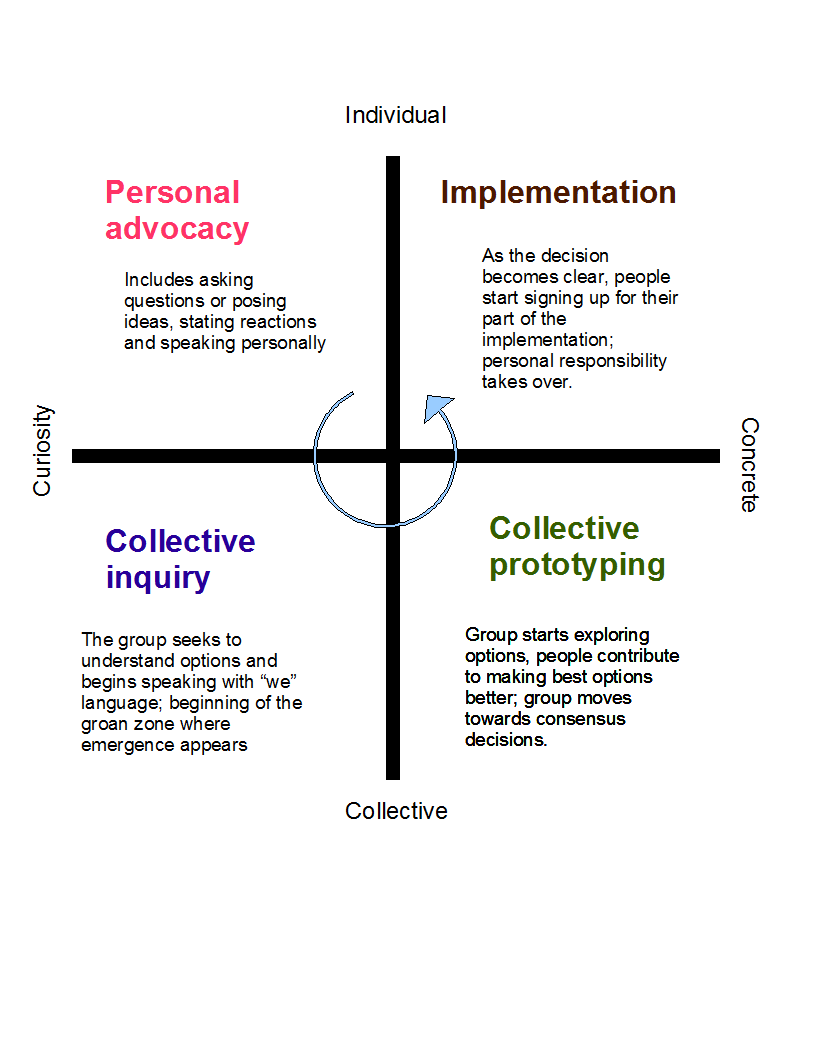 And this, Dave Pollard's:
 And it would seem that all this is based on something called the U-Process, developed by Otto Scharmer and friends. The U-process is a kind of framework for bringing about systemic change in all kinds of organisations and groups through a collective change process and is being applied here and there to try and tackle seemingly intractable problems. It looks something like this:
 All of this makes good sense in the context of the process that we have been following in order to help Seva Mandir prepare its 6th Comprehensive plan, the meetings that we hold on a regular basis in Seva Mandir and the workshops that we have been organising with the citizen's of Delwara. For example, during the recent meeting with the women or with the 'harijans' (members of the lowest caste group, victims of great discrimination and exclusion) we have to get from a group of disparate individuals, potentially in conflict with each other, to a collective with a shared identity and a commitment to each other. In order to do this, we must travel from 'I' to 'we'. We need to open up our hearts to each other and contemplate what being together means. This is the bottom of the U. At this stage there is a sense of vibration within the group - of being connected to each other - both through minds and hearts ... and it is elevating. Once we reach this stage, translating the shared energy into concrete plans of action becomes much easier. But the process is not always either easy or smooth... and sometimes we are only partly there...
Two stages jump out as being the real critical points that need to be examined in greater depth. One is the shift into presencing. How does it happen? How long should it be sustained? The other is the taking of personal responsibility after presencing - the co-creating... How deep was the presencing? Did it hit the nail on the head? Did it cause the shift deeply enough to take the members to a whole new level? What would this take? Once we get back in our old system, out of the U-experience, we are back in those old positions, old routines, interacting with the same old people reinacting the same old patterns? Sure, if we can maintain our separateness through our newly formed group we may be able to maintain the energy... But high fall-out can be expected...
And, well, it struck me that this process is a kind of fractal - in the sense that it applies to large groups, small groups and well, why not, I suppose... Individuals? Now what would this look like at the individual level? One thing is clear: whether we are engaging in this kind of a U-process at the organisation or group level, we are dealing first and foremost with individuals.
What goes on in the individual during this process? And is there a way that an individual can experience this same transition from one state to another on their own? Is it necessarily a collective process? Is it only through my being and doing with others that I can bring about transformation in myself? If not, is meditation or reflection what this looks like at the personal level? Do I have to disconnect myself from my daily life in order to get there? Am I already there? Can I do this willingly? Can I presence perpetually? Is it more about a state of being?
And can this be done at the level of a community as a whole? What would be the method? How would we get a multitude of fragmented individuals and groups to gradually 'vibrate in harmony' as it were? What is the deepest collective presencing possible for a whole community and how do we get there?
I don't know what the answers are to any of these questions... but they do look like they matter!
And, I suppose, this is where the work that Seva Mandir really fits in. It can provide not just the U experience but it can also do the groundwork to prepare for entry and do the follow-up work to support what comes after. It not only gets people ready to dive in, it not only helps them to access the source, but it also provides support in enacting whatever comes next. Still though, ultimate responsibility lies in the hands of the people themselves. We give no instructions.
But the real question is how deep we get in the U process. This seems key to everything. If we get to the source, where would it take us? What would it take for us to get there? I think we cannot know the answer until we walk the path... And convincing anyone to embark on something that has no clear destination is not easy - although it seems more and more people are talking about this - facilitators, knowledge management experts, and more. But, wedged in all the entanglements of organisational reality - accountability, reports, targets, and the like - how do we do this (by Tom Atlee, hat tip to Dave Pollard)? The unknown or everything that we know (however bad it may be)? How do we prepare people for this kind of trade-off?
My mission in life, forgive me for this, is to facilitate a conscious evolutionary process. Yes, I read these words today on Tom Atlee's site, but I have known this (in these very words) as long back as 6 years ago. In order to do this I need to understand exactly how we connect to the source in the most effective manner to bring about the individual and collective shifts that are required, to harmonise humanity with the flow of nature and liberate the full potential of human spirit. For this I need to know how to get people, systems and everyone else on-board. How to connect people in this quest in the most effective manner. This is what I need to learn. And this is what I need to get from my studies.
Let's see where this road takes me ;)
Wednesday, August 27, 2008
Women, unity, gifts and spirituality: the foundation for women led community development in Delwara
In the small multi-caste town of Delwara, a women's group has been formed. This group is a platform for women to come together on a common platform across all kinds of traditional divides - caste, religion, class, etc. - to become agents of their own destiny. This morning, I spent a few hours with the group exploring some of the following questions:
We also discussed the idea that each person present was bringing with them a gift. The group belongs to the women and it is nourished by the gifts that the women themselves bring. What are these gifts that the women bring? The ability to listen. A readiness to help those in need in whatever way possible. A spirit of cooperation and assistance. A desire to make a positive contribution in the world.
It struck me, as we engaged in this conversation, that we had reached a special level in the group. There was an emotional intensity, a sense of being part of something deep - perhaps even spiritual. The group was moving as a whole in a container that reverberated with the sense of collectivity that resonated from the women sitting there. This may only be my take on it though I do plan to check up on this feeling soon.
In some ways, I feel that I crossed a barrier, a boundary in the way that we usually dialogue. It is as though we made a shift from talking about mere practicalities or technicalities of rights, and government and frameworks and water tanks and pension schemes to tapping into the very soul of the women and its collective expression in their group. The words and emotions that were being exchanged were expressions of that individual and collective soul and, at the same time, the food that nourishes it. A deepening reminder of the fact that it is this level of conversation that connects the individual woman and her own soul to that of the group. In this sense it was both transcendental and palpable.
And what this really brings me to is something that I have felt for a long time but never really made a formal point of - and that is that this thing we call development really needs to be reframed as a spiritual process; a process of collective spiritual evolution. I do not feel that this is a dimension that finds adequate expression in the existing discourse around development - even in Seva Mandir. As we work on non-formal education centres, or village institutions, deal with targets and logical frameworks, worry about accountability and transparency, and so on... are we giving due attention to the fact that we are engaged in a process of spiritual evolution? Is there a space for this?
As an afternote: I really enjoyed working with Gulabji (who has replaced me as project coordinator in Delwara) today. He gave space where it was desired and support where it was required. He also was able to bring together spirituality across Hindu-Muslim divides in a seamless and natural manner and although we had not discussed our programme at any great length beforehand, it felt as though we were playing a familiar game. So my deep thanks and respect go out to this special soul!
- what is unity?
- how is unity created?
- how is unity destroyed?
- how is unity sustained?
We also discussed the idea that each person present was bringing with them a gift. The group belongs to the women and it is nourished by the gifts that the women themselves bring. What are these gifts that the women bring? The ability to listen. A readiness to help those in need in whatever way possible. A spirit of cooperation and assistance. A desire to make a positive contribution in the world.
It struck me, as we engaged in this conversation, that we had reached a special level in the group. There was an emotional intensity, a sense of being part of something deep - perhaps even spiritual. The group was moving as a whole in a container that reverberated with the sense of collectivity that resonated from the women sitting there. This may only be my take on it though I do plan to check up on this feeling soon.
In some ways, I feel that I crossed a barrier, a boundary in the way that we usually dialogue. It is as though we made a shift from talking about mere practicalities or technicalities of rights, and government and frameworks and water tanks and pension schemes to tapping into the very soul of the women and its collective expression in their group. The words and emotions that were being exchanged were expressions of that individual and collective soul and, at the same time, the food that nourishes it. A deepening reminder of the fact that it is this level of conversation that connects the individual woman and her own soul to that of the group. In this sense it was both transcendental and palpable.
And what this really brings me to is something that I have felt for a long time but never really made a formal point of - and that is that this thing we call development really needs to be reframed as a spiritual process; a process of collective spiritual evolution. I do not feel that this is a dimension that finds adequate expression in the existing discourse around development - even in Seva Mandir. As we work on non-formal education centres, or village institutions, deal with targets and logical frameworks, worry about accountability and transparency, and so on... are we giving due attention to the fact that we are engaged in a process of spiritual evolution? Is there a space for this?
As an afternote: I really enjoyed working with Gulabji (who has replaced me as project coordinator in Delwara) today. He gave space where it was desired and support where it was required. He also was able to bring together spirituality across Hindu-Muslim divides in a seamless and natural manner and although we had not discussed our programme at any great length beforehand, it felt as though we were playing a familiar game. So my deep thanks and respect go out to this special soul!
Monday, August 11, 2008
social objects as medium for change - v2
After writing that last post, I came up with a slightly more elaborate diagram for thinking about social objects and how they fit into the social change process that Seva Mandir is trying to bring about... It's a skill I'm trying to develop (the diagramming that is) ;p
 There are still a lot of question marks in my mind about this - and there are a lot of black/grey boxes that are in real need of getting opened up. This is especially the case with the design of the social object (and not just its actual design but the way that the designing itself fits into the overall process), and the issue of how convergence or co-evolution of the values takes place through dialogue and action around the social object.
I have also made a special effort to include resources as one of the attributes that communities bring to the table (rather than just needs) as I fear that we sometimes forget that communities do have resources - and I don't just mean Rs.5 a month - I'm talking more about knowledge and insights about what can work and what can't and why... and probably a lot more than that too!
Which brings me back to that oh-so-critical question of what, exactly the community is... and, if it's really so fragmented, then (a) can I still get away with calling it a community?; and (b) how can the social object and associated process be used to actually nourish community and make it vibrant? If community is both a means and an end (which means it implies something normative) - if it is our purpose-idea - if we really believe that the answer to all of the problems we are facing stem out of a severe loss of social cohesion, of community, then what we really need to be studying in a very rigorous way is just how, exactly, community gets built. And that is what this line of inquiry is all about!
On we go!
 There are still a lot of question marks in my mind about this - and there are a lot of black/grey boxes that are in real need of getting opened up. This is especially the case with the design of the social object (and not just its actual design but the way that the designing itself fits into the overall process), and the issue of how convergence or co-evolution of the values takes place through dialogue and action around the social object.
I have also made a special effort to include resources as one of the attributes that communities bring to the table (rather than just needs) as I fear that we sometimes forget that communities do have resources - and I don't just mean Rs.5 a month - I'm talking more about knowledge and insights about what can work and what can't and why... and probably a lot more than that too!
Which brings me back to that oh-so-critical question of what, exactly the community is... and, if it's really so fragmented, then (a) can I still get away with calling it a community?; and (b) how can the social object and associated process be used to actually nourish community and make it vibrant? If community is both a means and an end (which means it implies something normative) - if it is our purpose-idea - if we really believe that the answer to all of the problems we are facing stem out of a severe loss of social cohesion, of community, then what we really need to be studying in a very rigorous way is just how, exactly, community gets built. And that is what this line of inquiry is all about!
On we go!
A new line of inquiry: social objects as medium for change
I have been thinking about social objects (a la Hugh of gaping void) for a while now - particularly in the context of the kind of work that Seva Mandir is involved in - i.e. 'community development'.
 Essentially this diagram is trying to say that the social object is the interface between Seva Mandir and the community. It is then trying to point out that the social object is active or effective to the extent that it is able to find resonance at the level of such factors as 'shared values', and 'resources that meet needs'. Admittedly, this isn't saying a great deal. The really critical aspect of all this is how the social object leads to change...
The answer, as far as am I concerned is 'dialogue' or 'conversation'? Conversations that achieve convergence of the values. Conversations that match resources with needs. And then, there is the question of whether or how the conversations are able to influence the design of the social object itself! Do we simply deliver ready-made, pre-packaged solutions to the community or are we all engaged together in a continuous process of evolving these solutions based on local conditions? How might/does this impact on the direction and quality of the social change process?
Drawing on my experience to date, I have started thinking about what some of the answers to some of the first three questions might be and I have also started thinking that taking up these questions as new line of inquiry - possibly one combined with workshops and trainings involving staff across the organisation - and especially the front-line staff- could have a rather profound effect on how the work gets carried out on the ground.
Here are some quick responses to the questions that seem to be bubbling up:
1. What are the social objects through which our relationship with the community is mediated?
These objects seem to fit into distinct categories - some are more direct and tangible others less so.
The direct and tangible ones include things like: non-formal education centres, meetings, lift irrigation systems, forestry projects, a health camp...
The indirect and intangible ones include things like: objectives, values, ideas, images, metaphors, targets, responsibilities... perhaps these cannot be called social objects? Are they properties of the social objects or do they exist in their own right?
I think there's probably some kind of a matrix that can be constructed here...
2. How, exactly, do these social objects mediate our relationships with the community?
I suppose this question is really getting at the matter of how the social objects - the way they are lived (constructed, interpreted, understood?) by people - contribute to (enable, enhance or constrain) - the change process... At another (deeper?) level this is also a question of how they determine or shape the quality of the relationships that exist between the organisation and the community... which feeds back into the first question... What are the various factors that influence this?
One part of this inquiry would probably involving using a bit of ethnomethodology or something of the sort to really start looking at how the meaning of the social objects is actually articulated and lived by the various stakeholders... This would hopefully generate the kind of evidence that can be used to understand the dynamics of the process through which different relationships based on different sets of meaning and experience are brought to life... And this, perhaps, could be used to design interventions in a manner that more intentionally emphasises the positive transformation that we all (hopefully) end up desiring.
For example is 'a target' itself a social object or is 'target' a property of a more tangible social object - like' a non-formal education centre'? How does 'target' affect the relationship between staff and community? How does it affect the way that people relate to the social object itself and how does it affect such critical factors as the transfer of values and the occurence of social change? I think there is rather a lot to be explored here and some detailed case-studies would be required...
3. What are the implications for how they contribute to a desirable change process (and, therefore, what we ought to do about it all)?
This question follows on from where the previous question leads us... It probably needs to be taken a little further, beyond understanding the dynamics of the process towards the all important question of how we use our new understanding to make the social objects (however we end up framing them) more effective catalysts of 'desirable' change.
Now, one of the critical questions that I seem to be skirting around here is the question of what, exactly, constitutes 'desirable' change. Who gets to frame it? How do we judge if this really is desirable? Is joint inquiry with the community adequate or do we need something more? This is the real sensitive stuff and everything that we do - assuming we discover a way of being wildly successful - will have this 'desirable' element embedded into it.
And this leads us back to the really critical issue of 'conversations'. How do we structure our conversations around the social objects that we are creating or co-creating with the community as an interface for social change? Are there simpler or more effective ways of going about this than what we have already discovered?
If I can get deep enough into this inquiry then perhaps it will be possible to really uncover some valuable material and develop some deep processes maps... I'm especially thinking in terms of some recent questions that have been surfacing in my work, mind and conversations about what, exactly, we mean by community (does it exist yet?) and how we can leverage the rampant fragmentation in the communities we work with through the designs of our interventions, thereby enhancing our ability to actually build (or rebuild) community. It would also be really interesting to see how all of this can be woven into a process that simultaneously enhances the capacity of the organisation and its staff to engage within this kind of a framework!
A lot of questions. Far fewer answers. But something to get the appetite throbbing!
"The Social Object, in a nutshell, is the reason two people are talking to each other, as opposed to talking to somebody else."In this line of work social objects are our medium for bringing about change within a community. They are the objects that cause people (staff and community) to engage with each other and bring about change. This line of thinkin"g led me to the the following two questions...
- What are the social objects through which our relationship with the community is mediated?
- How, exactly, do these social objects mediate our relationships with the community?
- What are the implications for how they contribute to a desirable change process?
 Essentially this diagram is trying to say that the social object is the interface between Seva Mandir and the community. It is then trying to point out that the social object is active or effective to the extent that it is able to find resonance at the level of such factors as 'shared values', and 'resources that meet needs'. Admittedly, this isn't saying a great deal. The really critical aspect of all this is how the social object leads to change...
The answer, as far as am I concerned is 'dialogue' or 'conversation'? Conversations that achieve convergence of the values. Conversations that match resources with needs. And then, there is the question of whether or how the conversations are able to influence the design of the social object itself! Do we simply deliver ready-made, pre-packaged solutions to the community or are we all engaged together in a continuous process of evolving these solutions based on local conditions? How might/does this impact on the direction and quality of the social change process?
Drawing on my experience to date, I have started thinking about what some of the answers to some of the first three questions might be and I have also started thinking that taking up these questions as new line of inquiry - possibly one combined with workshops and trainings involving staff across the organisation - and especially the front-line staff- could have a rather profound effect on how the work gets carried out on the ground.
1. What are the social objects through which our relationship with the community is mediated?
These objects seem to fit into distinct categories - some are more direct and tangible others less so.
The direct and tangible ones include things like: non-formal education centres, meetings, lift irrigation systems, forestry projects, a health camp...
The indirect and intangible ones include things like: objectives, values, ideas, images, metaphors, targets, responsibilities... perhaps these cannot be called social objects? Are they properties of the social objects or do they exist in their own right?
I think there's probably some kind of a matrix that can be constructed here...
2. How, exactly, do these social objects mediate our relationships with the community?
I suppose this question is really getting at the matter of how the social objects - the way they are lived (constructed, interpreted, understood?) by people - contribute to (enable, enhance or constrain) - the change process... At another (deeper?) level this is also a question of how they determine or shape the quality of the relationships that exist between the organisation and the community... which feeds back into the first question... What are the various factors that influence this?
One part of this inquiry would probably involving using a bit of ethnomethodology or something of the sort to really start looking at how the meaning of the social objects is actually articulated and lived by the various stakeholders... This would hopefully generate the kind of evidence that can be used to understand the dynamics of the process through which different relationships based on different sets of meaning and experience are brought to life... And this, perhaps, could be used to design interventions in a manner that more intentionally emphasises the positive transformation that we all (hopefully) end up desiring.
For example is 'a target' itself a social object or is 'target' a property of a more tangible social object - like' a non-formal education centre'? How does 'target' affect the relationship between staff and community? How does it affect the way that people relate to the social object itself and how does it affect such critical factors as the transfer of values and the occurence of social change? I think there is rather a lot to be explored here and some detailed case-studies would be required...
3. What are the implications for how they contribute to a desirable change process (and, therefore, what we ought to do about it all)?
This question follows on from where the previous question leads us... It probably needs to be taken a little further, beyond understanding the dynamics of the process towards the all important question of how we use our new understanding to make the social objects (however we end up framing them) more effective catalysts of 'desirable' change.
Now, one of the critical questions that I seem to be skirting around here is the question of what, exactly, constitutes 'desirable' change. Who gets to frame it? How do we judge if this really is desirable? Is joint inquiry with the community adequate or do we need something more? This is the real sensitive stuff and everything that we do - assuming we discover a way of being wildly successful - will have this 'desirable' element embedded into it.
And this leads us back to the really critical issue of 'conversations'. How do we structure our conversations around the social objects that we are creating or co-creating with the community as an interface for social change? Are there simpler or more effective ways of going about this than what we have already discovered?
If I can get deep enough into this inquiry then perhaps it will be possible to really uncover some valuable material and develop some deep processes maps... I'm especially thinking in terms of some recent questions that have been surfacing in my work, mind and conversations about what, exactly, we mean by community (does it exist yet?) and how we can leverage the rampant fragmentation in the communities we work with through the designs of our interventions, thereby enhancing our ability to actually build (or rebuild) community. It would also be really interesting to see how all of this can be woven into a process that simultaneously enhances the capacity of the organisation and its staff to engage within this kind of a framework!
A lot of questions. Far fewer answers. But something to get the appetite throbbing!
Thursday, August 7, 2008
social capital - possibility is in our hands
Another long-standing topic that I am finally getting around to putting on my blog... and a good follow-up for the previous blog. It struck me one day in Delwara as I found myself trying to stop two 'community leaders' from neighbouring communities - one a tribal (Gameti) the other a scheduled caste (Meghwal - traditionally tanners/leather-workers).
The fight was over some misunderstanding/miscommunication rather than any real transgression though there were some territorial undertones. I was standing on top of a pile of sand on top of the hill upon which the tribal community has built their basti. It's a beautiful location and the houses there have the best view of the whole village - including the Devigarh fort. Of course, it's cramped up there, there's no water supply (a real problem for the women and young girls who fetch it), and the community is one of the poorest in the village so - relative freedom aside - life is pretty tough for the inhabitants.
I once watched an 80 year-old man on top of that hill crushing rocks next to a 4x6 foot stone cubicle with no roof (which, I discovered later was his home). This involve hammering a 6" iron nail into the rocky ground by banging it with a big stone. In the corner of the cubicle was a little hand-made earthern stove with some ashes at the bottom of it. The old man was too old to really earn any money through labour work. He got most of his meals from the neighbours - which they gave up with what seemed like a mix of reluctance and obligation. After the community sent an application to the citizen's forum, roofing was arranged - just in time to keep his home dry as the monsoon rains started a few days later. By the time we went to put the roof up, he had expanded his house to around 7x6 feet using the stones he had been crushing right there on the spot. Amazing.
In any case, back to the fight. So, there had been some miscommunication. The meghwal chap was working as a mason on the construction work of a water tank. Some mistrust had emerged over the issue of whether work was properly being distributed between therespective labourers of the tribal and the Meghwal community. By the time I was at the site, the situation was pretty bad. There was shouting, throwing of insults, angry faces, high BP, and people throwing their hands up in the air. It reached the point where the parties were shouting that no water tank would be built in that location. Well, there goes the reliable, convenient water source for about 50 families.
As I stood on top of that hill and calmed the people down, shifted the blame onto myself and my team (we did have an unfortunate hand in propagating the miscommunication - it happens sometimes that false information circulates unintentionally in the messy, complex chaos that gets called 'the community') , calmed the two people down, and re-established the fact that the water tank really was a good idea and that everything was going to be ok I found myself thinking about social capital... and my thoughts went something like this...
Social capital is a form of 'the commons'. It is, perhaps, the most fundamental form of 'the commons'. Traditionally 'the commons' has referred to natural resources - initially pasture lands on which shepherds could graze their cattle and later it has expanded to include things like the climate or biodiversity. But my sense is that we really need to start talking about what it is that holds all these things together - what it is that we need to restore if we want to address the tragedy of these commons. And that thing is social capital: our relationships and the potential they represent for enriching lives.
Social capital is the common resource that has been most ignored and most overlooked in the general discourse on the commons. It is like a vast, untapped - almost infinite - sea - like the internet - source of potential for creating the world in new and wonderful ways. If we have high levels of social capital - deep, meaningful relationships with each other that are bursting with opportunities for collaboration - jointly making things happen in ways that are mutually beneficial - then what can't we achieve?
Unlike the traditional and modern commons - our grazing lands and the ecosphere for example - social capital (can we venture calling it community?) has a direct link with our assumptions, biases and prejudices: the way we perceive ourselves, others and the relationship in-between. For example, do we distinguish people - either consciously or unconsciously - according to religion, caste, gender, age, class, education status, appearance, position within an organisation? Do we assign different levels of trust/mistrust based on this? Do we open or close opportunities for working together or, for that matter, even talking to each other based on this?
Every time I make a judgement based on identity and foreclose an interaction, an opportunity to understand, listen, engage and build a relationship, I am simultaneously denying myself and the other person an opportunity to acquire social capital. And this appears to be the most defining feature of what still seems to get called 'community' in this communally dilapidated age. Walls exist everywhere, between everyone, and the result is a bunch of isolated people who can't even have the conversations that they need to have to begin thinking about what it would take to change the world for the better.
I'm not entirely sure what I'm trying to get at here but I think the main point is that if we want to ever start the process of addressing the world's biggest problems we need to engage in a very real way with some of the very smallest. Why do I call it the smallest? Well, given my (perhaps naieve) sense of how the world works - one's own behaviour is the only thing that one really has any control over. I'm not trying to say that it's easy and I don't mean to sound corny but it really does make sense. So it seems that part of saving the world is helping people to realise that they can have control over themselves, and that collectively, if a group of individuals can wake up to this call for taking responsibility for their own behaviour, they can access a vast sea of social capital just waiting to be unleashed as a force for creating a better world together
Create the opportunities - the spaces and the call to get inside them and tap into the source of community. Let them do it!
The fight was over some misunderstanding/miscommunication rather than any real transgression though there were some territorial undertones. I was standing on top of a pile of sand on top of the hill upon which the tribal community has built their basti. It's a beautiful location and the houses there have the best view of the whole village - including the Devigarh fort. Of course, it's cramped up there, there's no water supply (a real problem for the women and young girls who fetch it), and the community is one of the poorest in the village so - relative freedom aside - life is pretty tough for the inhabitants.
I once watched an 80 year-old man on top of that hill crushing rocks next to a 4x6 foot stone cubicle with no roof (which, I discovered later was his home). This involve hammering a 6" iron nail into the rocky ground by banging it with a big stone. In the corner of the cubicle was a little hand-made earthern stove with some ashes at the bottom of it. The old man was too old to really earn any money through labour work. He got most of his meals from the neighbours - which they gave up with what seemed like a mix of reluctance and obligation. After the community sent an application to the citizen's forum, roofing was arranged - just in time to keep his home dry as the monsoon rains started a few days later. By the time we went to put the roof up, he had expanded his house to around 7x6 feet using the stones he had been crushing right there on the spot. Amazing.
In any case, back to the fight. So, there had been some miscommunication. The meghwal chap was working as a mason on the construction work of a water tank. Some mistrust had emerged over the issue of whether work was properly being distributed between therespective labourers of the tribal and the Meghwal community. By the time I was at the site, the situation was pretty bad. There was shouting, throwing of insults, angry faces, high BP, and people throwing their hands up in the air. It reached the point where the parties were shouting that no water tank would be built in that location. Well, there goes the reliable, convenient water source for about 50 families.
As I stood on top of that hill and calmed the people down, shifted the blame onto myself and my team (we did have an unfortunate hand in propagating the miscommunication - it happens sometimes that false information circulates unintentionally in the messy, complex chaos that gets called 'the community') , calmed the two people down, and re-established the fact that the water tank really was a good idea and that everything was going to be ok I found myself thinking about social capital... and my thoughts went something like this...
Social capital is a form of 'the commons'. It is, perhaps, the most fundamental form of 'the commons'. Traditionally 'the commons' has referred to natural resources - initially pasture lands on which shepherds could graze their cattle and later it has expanded to include things like the climate or biodiversity. But my sense is that we really need to start talking about what it is that holds all these things together - what it is that we need to restore if we want to address the tragedy of these commons. And that thing is social capital: our relationships and the potential they represent for enriching lives.
Social capital is the common resource that has been most ignored and most overlooked in the general discourse on the commons. It is like a vast, untapped - almost infinite - sea - like the internet - source of potential for creating the world in new and wonderful ways. If we have high levels of social capital - deep, meaningful relationships with each other that are bursting with opportunities for collaboration - jointly making things happen in ways that are mutually beneficial - then what can't we achieve?
Unlike the traditional and modern commons - our grazing lands and the ecosphere for example - social capital (can we venture calling it community?) has a direct link with our assumptions, biases and prejudices: the way we perceive ourselves, others and the relationship in-between. For example, do we distinguish people - either consciously or unconsciously - according to religion, caste, gender, age, class, education status, appearance, position within an organisation? Do we assign different levels of trust/mistrust based on this? Do we open or close opportunities for working together or, for that matter, even talking to each other based on this?
Every time I make a judgement based on identity and foreclose an interaction, an opportunity to understand, listen, engage and build a relationship, I am simultaneously denying myself and the other person an opportunity to acquire social capital. And this appears to be the most defining feature of what still seems to get called 'community' in this communally dilapidated age. Walls exist everywhere, between everyone, and the result is a bunch of isolated people who can't even have the conversations that they need to have to begin thinking about what it would take to change the world for the better.
I'm not entirely sure what I'm trying to get at here but I think the main point is that if we want to ever start the process of addressing the world's biggest problems we need to engage in a very real way with some of the very smallest. Why do I call it the smallest? Well, given my (perhaps naieve) sense of how the world works - one's own behaviour is the only thing that one really has any control over. I'm not trying to say that it's easy and I don't mean to sound corny but it really does make sense. So it seems that part of saving the world is helping people to realise that they can have control over themselves, and that collectively, if a group of individuals can wake up to this call for taking responsibility for their own behaviour, they can access a vast sea of social capital just waiting to be unleashed as a force for creating a better world together
Create the opportunities - the spaces and the call to get inside them and tap into the source of community. Let them do it!
Monday, August 4, 2008
community based organisations vs. organised communities
So, I've had this long-standing thought about working with communities... I have this notion that it's not particularly original but all the same it strikes me as worth noting down - especially as I'm in need the middle of preparing a proposal that builds on this idea.
Most of the development discourse - and I suppose I'm talking here about the mainstream stuff - seems to talk about what they call CBOs - Community Based Organisations. This term refers to just about any type of organisation that consist of people who live within a geographically bounded area. In general, big implementing agencies like to work with 'CBOs' because they contribute to the 'sustainability' of the intervention being implemented and project the image of being community-centred and participatory. OK.
However, there's something I don't like about the term 'CBO'. Is it to do with the way that it doesn't really do justice to the very notion of community? For that matter, what is a community? Isn't a community form of organisation in its own right? And if it is, are we really treating it like one? How can we re-frame these questions and ideas in a way that gives them more meaning and brings them more to life?
These kinds of questions led me to the idea of talking about 'organised communities' rather than 'community based organisations'. The question then becomes not one of how strong is the community based organisation but one of how strong is the community. This then leads us to confront what we are actually talking about when we talk about community. What is a community? What would we like our community to be like? What are the fears we have about the future of our community? What are the hopes we have for the future of our community?
Community itself seems so much more rich and meaningful a concept than CBO. CBO doesn't seem to carry any sense of neighbours caring about each other, of people being engaged in celebrations or festivals together: it seems well and truly void of culture. This, I believe is one of the great dangers of most development work: it tends to ignore the vast realm of culture. And I don't mean preserving traditional culture - I mean thinking about 'development' as a process of bringing about intentional, positive, cultural change through a process of dialogue combined with action.
Community is all about relationships. The work that we really ought to be doing is helping to make these relationships deep, fulfilling, meaningful, mutually empowering. Somehow, this sees far more important and pressing than the idea of setting up some kind of a semi-formal CBO with management capabilities.
Most of the development discourse - and I suppose I'm talking here about the mainstream stuff - seems to talk about what they call CBOs - Community Based Organisations. This term refers to just about any type of organisation that consist of people who live within a geographically bounded area. In general, big implementing agencies like to work with 'CBOs' because they contribute to the 'sustainability' of the intervention being implemented and project the image of being community-centred and participatory. OK.
However, there's something I don't like about the term 'CBO'. Is it to do with the way that it doesn't really do justice to the very notion of community? For that matter, what is a community? Isn't a community form of organisation in its own right? And if it is, are we really treating it like one? How can we re-frame these questions and ideas in a way that gives them more meaning and brings them more to life?
These kinds of questions led me to the idea of talking about 'organised communities' rather than 'community based organisations'. The question then becomes not one of how strong is the community based organisation but one of how strong is the community. This then leads us to confront what we are actually talking about when we talk about community. What is a community? What would we like our community to be like? What are the fears we have about the future of our community? What are the hopes we have for the future of our community?
Community itself seems so much more rich and meaningful a concept than CBO. CBO doesn't seem to carry any sense of neighbours caring about each other, of people being engaged in celebrations or festivals together: it seems well and truly void of culture. This, I believe is one of the great dangers of most development work: it tends to ignore the vast realm of culture. And I don't mean preserving traditional culture - I mean thinking about 'development' as a process of bringing about intentional, positive, cultural change through a process of dialogue combined with action.
Community is all about relationships. The work that we really ought to be doing is helping to make these relationships deep, fulfilling, meaningful, mutually empowering. Somehow, this sees far more important and pressing than the idea of setting up some kind of a semi-formal CBO with management capabilities.
Thursday, July 24, 2008
visions, dreams, problem-solving and change
So, I’m pretty sure that I’m not saying anything new here (I have been thinking about it for a while and have taken inspiration from numerous sources and even woven it into my own practice)… but it does kind of strike me as being rather important… here it goes:
One thing is for sure: the dream-based leadership workshop that we conducted in Delwara – which included an exercise for linking people’s own actions to the realization of their dreams – worked! Within a few days, a Muslim lady – a local leader – was out and about in her neighbourhood trying to collect money from each household to cover the cost of getting the neighbourhood cleaned on a regular basis. And just the other day, I was translating for a volunteer studying the relationship between women and water in Delwara, and two women quite clearly recounted: “it’s not that we didn’t have dreams before the Citizen’s Forum was established, it’s just that we didn’t have a way of realizing them”.
This is an urgent plea to not let ourselves start trying to possess other people’s dreams and to focus instead on trying simply to listen to, know and understand them, to get people to own up to having them and to cultivate a passion for realizing them – both individually and collectively!
I sincerely believe that these dreams are the source from which any glimmer of hope for positive social change emerges. As such, they are worthy of unfathomable respect.
- Vision-driven change is completely different from problem-solving-driven change.
- For the most-part, people are uncomfortable with moving away from problem-solving
- Vision-driven change requires an understanding of the problems but, instead of beginning with the problems, begins with tapping into people’s dreams, unearthing them, sharing them, building common dreams and then catalyzing collective action around these dreams
- Vision-driven change and problem-solving-driven change are not mutually exclusive… but putting the vision gives a better context for the problem-solving
- Vision-driven change is all about creating new realities – this gives a real sense of moving forward towards something that is desirable rather than simply away (or aside from) something that is bad
- Problem-solving change is all about trying to get out of slippery holes – getting out of one doesn’t mean that you haven’t fallen into another
- Vision-driven change is holistic, and presents an inclusive and clear goal that people can both relate and aspire to
- Problem-solving change is fragmented, and often fails to consider how one problem is linked to the next – it also often encourages looking for solutions at levels that are far beyond people’s grasp
One thing is for sure: the dream-based leadership workshop that we conducted in Delwara – which included an exercise for linking people’s own actions to the realization of their dreams – worked! Within a few days, a Muslim lady – a local leader – was out and about in her neighbourhood trying to collect money from each household to cover the cost of getting the neighbourhood cleaned on a regular basis. And just the other day, I was translating for a volunteer studying the relationship between women and water in Delwara, and two women quite clearly recounted: “it’s not that we didn’t have dreams before the Citizen’s Forum was established, it’s just that we didn’t have a way of realizing them”.
This is an urgent plea to not let ourselves start trying to possess other people’s dreams and to focus instead on trying simply to listen to, know and understand them, to get people to own up to having them and to cultivate a passion for realizing them – both individually and collectively!
I sincerely believe that these dreams are the source from which any glimmer of hope for positive social change emerges. As such, they are worthy of unfathomable respect.
Subscribe to:
Posts (Atom)